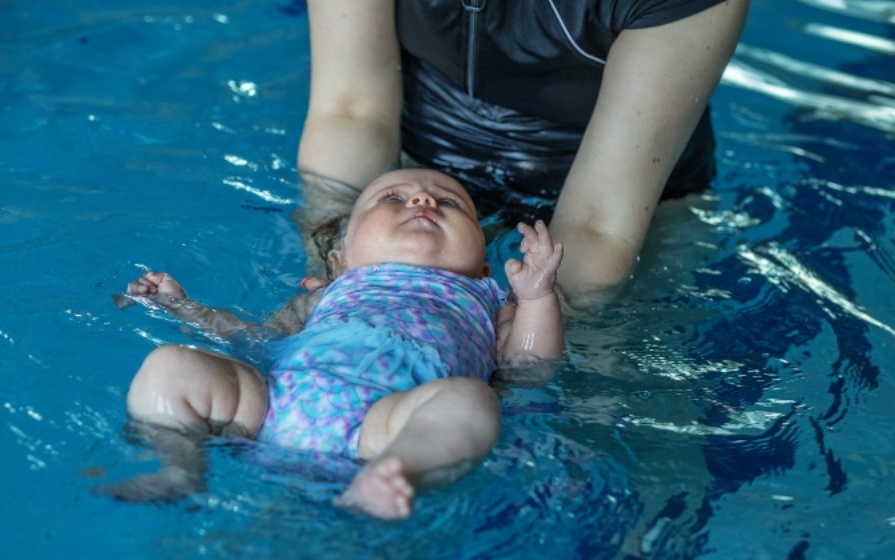
The American Academy of Pediatrics recommends that formal swim lessons begin for many children starting at age 1, once increasing mobility raises the risk of unsupervised water access.
Babies under 1 can safely enjoy parent-child water play classes for comfort and bonding, but there is currently no evidence that infant swim programs for babies under 1 actually reduce drowning risk. Drowning remains the leading cause of death for children ages 1 to 4 in the United States, which makes the timing question a genuinely important one for parents, not just a scheduling preference.
Many parents researching Infant Swim Classes Denver CO, are looking for the right balance between water confidence and water safety. Understanding what lessons can realistically teach at each stage of development helps families choose programs that match their child’s age and abilities.
Here is what the current guidance actually says and why the age matters.
Why Age 1 Is the Guidance, Not Younger
It might seem intuitive that earlier is always safer, but the research does not support that assumption for infants under 12 months. Infants at this age may show reflex “swimming” movements in water, but they cannot yet reliably raise their heads out of the water to breathe on their own. This developmental limitation is the core reason infant swim programs for babies under 1 have not been shown to reduce drowning risk, regardless of how the class is marketed.
The AAP’s updated guidance specifically frames swim lessons beginning after a child’s first birthday as appropriate because increasing mobility at that age, crawling, walking, and general curiosity, raises the practical risk of a toddler gaining unsupervised access to water. A 6-month-old cannot wander toward a pool on their own.
A 15-month-old often can, which changes the calculus around what protective skills are actually useful at that stage.
What’s Appropriate Before Age 1
Even though formal swim instruction is not recommended before 12 months, that does not mean water time itself is off the table. Parent-child water play classes, where a caregiver is in the water with the baby the entire time, are considered a reasonable and enjoyable activity for infants 6 to 12 months old. These classes focus on comfort and familiarity with water rather than actual swim skill development, and there is no evidence that they reduce drowning risk on their own. Think of this stage as building comfort, not competence.
What Changes as Children Get Older
By around age 4, most children are developmentally ready for more structured lessons and can typically learn genuine water survival skills, including floating, treading water, and reaching an exit point on their own. By age 5 or 6, many children in ongoing lessons can master the front crawl and more advanced strokes.
This progression matters because it reflects real developmental milestones, not arbitrary age cutoffs. Children develop at different rates, so a child’s emotional maturity, physical ability, and comfort level in water should factor into the decision alongside their exact age. A pediatrician can help assess whether an individual child is ready, particularly if there is any uncertainty.
Swim Lessons Are One Layer, Not a Complete Solution
This is one of the most important points in current guidance, and one that is easy to miss when parents feel reassured after enrolling in lessons. Formal swimming lessons can reduce the risk of drowning, but children who have completed swim lessons still need close and constant supervision whenever they are in or near water. No single method, including swim lessons, is considered sufficient on its own to prevent drowning.
The full layered approach recommended by pediatric and public health organizations includes constant, attentive adult supervision whenever a child is in or near water, four-sided pool fencing that separates the pool from the house and yard with self-closing, self-latching gates, immediate removal of standing water from buckets, kiddie pools, and bathtubs after use, and CPR training for parents and caregivers.
Notably, four-sided isolation fencing that separates the pool from the house reduces a child’s drowning risk by 83 percent compared to fencing that only encloses the yard’s perimeter. This single change is one of the most effective prevention measures available, arguably more impactful than swim lessons alone.
Understanding the Real Risk Numbers
Drowning statistics make clear why timing and layered prevention matter so much. Drowning is the leading cause of death among children ages 1 to 4 in the United States, and among children ages 5 to 14, it is the second leading cause of unintentional injury death, behind only motor vehicle crashes. Among infants under 1 year old specifically, most drownings happen in bathtubs rather than pools, which is a useful reminder that pool fencing and swim lessons do not address every water risk a young child faces.
Choosing a Quality Learn-to-Swim Program
Once your child reaches an appropriate age, look for programs that go beyond stroke technique and focus on broader water survival competency. A strong program should teach a child how to get back to the surface from underwater, propel themselves a meaningful distance, and get out of the water independently, not just perform strokes with a floatation device.
Ask instructors about their certification, class size, and what water safety skills, beyond swimming technique, are actually part of the curriculum. Smaller class sizes generally allow for more individual attention, which matters significantly for very young swimmers.
If you are exploring infant swim classes in Denver, CO, it is worth confirming directly with the program whether their curriculum for children under 1 is framed as comfort-building water play rather than being marketed as a drowning-prevention swim lesson, since that distinction reflects current pediatric guidance accurately.
Frequently Asked Questions
Is it ever too late to start swim lessons for an older child? No. While earlier instruction has benefits, children and even adults can safely learn water survival skills and swimming at any age. If your older child has not yet had lessons, it is still worth prioritizing, since the skills remain valuable regardless of starting age.
Do swim lessons need to continue year-round, or is a single course enough? Swimming is a skill that requires ongoing practice to maintain and build upon, similar to any other physical skill. A single course introduces foundational skills, but consistent, ongoing lessons over multiple seasons produce more reliable water competency than a one-time class.
Should children with epilepsy or autism spectrum disorder follow different swim lesson guidance? These children face measurably higher drowning risk and benefit from tailored counseling from their pediatrician regarding water safety, supervision levels, and swim instruction timing. Adapted aquatics programs designed for children with disabilities are also available in many areas and are worth asking about directly.