While using Amazon as a brand's platform, the listing is much more than just a place where the product is presented. The listing becomes the sales page that will help customers evaluate the quality of the item and choose between alternatives to determine whether or not the product is worth purchasing. This makes A+ Content a significant component of the successful Amazon listing.
There are two types of A+ Content offered by Amazon – Basic and Premium A+. Both of these types can be effective in developing a good listing, although each provides its own creative opportunities for doing so. The choice between the two types is up to your needs and priorities.
What Is Basic Amazon A+ Content?
Basic A+ allows users to improve the product description section with the help of designed images, placement of text, branded headings, and product comparison tables. Rather than listing all the information in lengthy paragraphs, the sellers can create visually appealing modules that are easy to read.
For instance, a skincare company may use image/text modules to show the ingredients used in their products, how to apply the product, and what skin problems it will solve. An electronics seller can use diagrams and tables to highlight specifications, compatibility, and accessories of the product.
Basic A+ helps when the buyers require more information but do not need demonstrations.
What Is Premium A+ Content?
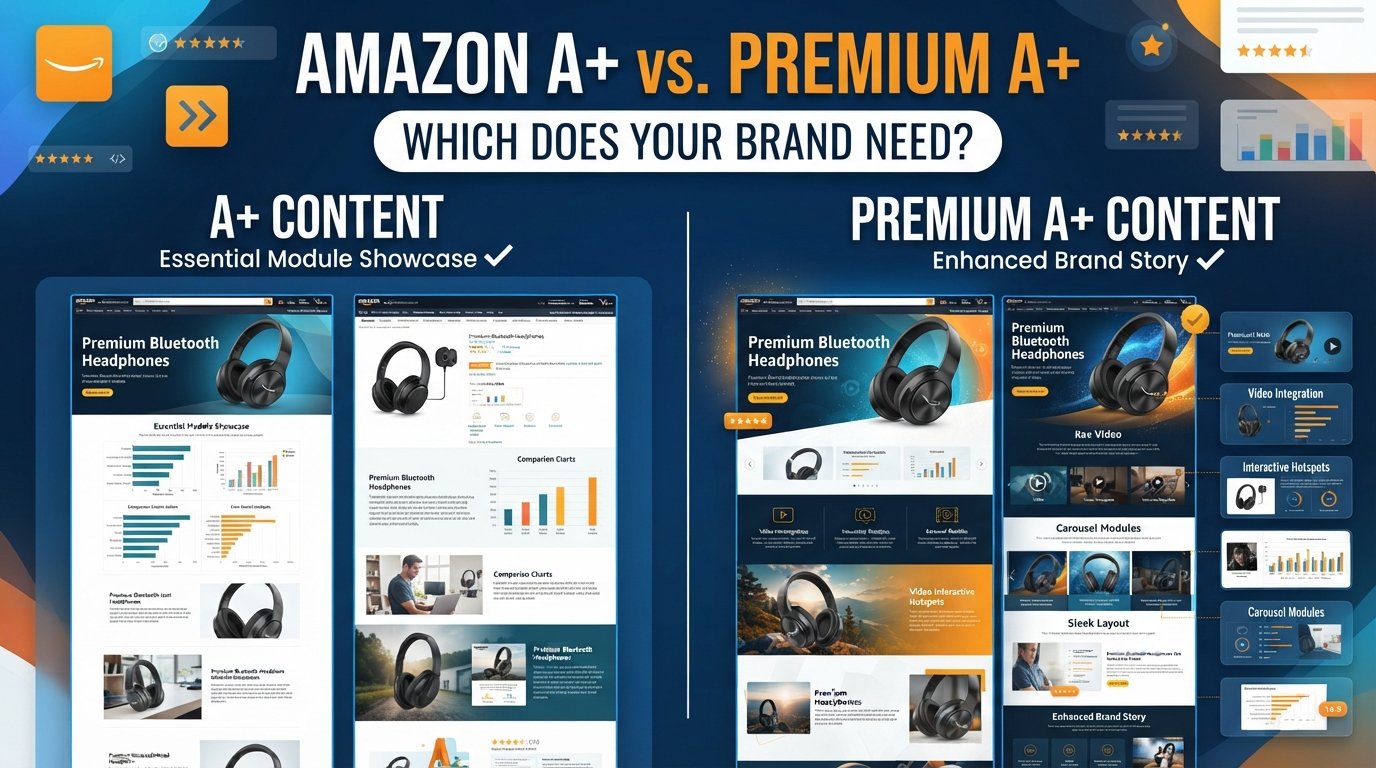
Premium A+ provides a step-up to the basic package in terms of having more engaging content and better visual possibilities. Based on the available options for the selected plan, companies can use large photos, multi-video modules, interactive hot spots, photo or video carousel, comparison chart, Q&A section. Such options would be valuable for products whose features are shown much easier than explained. A company selling kitchen appliances can make a video of its working. Furniture companies can use hot spots to highlight particular materials, dimensions, or features in its lifestyle photo. Technology companies can use a carousel to show what the product can do.
The usefulness of Premium A+ does not depend on whether one will select it automatically.
Basic A+ vs. Premium A+: Key Differences
The distinction lies in how interactive and presented things are. Standard A+ emphasizes advanced text and graphics with comparisons. A+ Plus provides more visual and interactive features.
| Feature | Basic A+ Content | Premium A+ Content |
|---|---|---|
| Text and images | Available | Available |
| Customised layouts | Available | Available |
| Product comparison charts | Available | Enhanced options |
| Larger visual modules | Standard formats | More expansive formats |
| Video modules | Not included in standard A+ modules | Available |
| Interactive hotspots | Not included | Available |
| Image or video carousels | Not included | Available |
| Q&A module | Not included | Available |
| Best suited to | Straightforward products and developing brands | Detail-rich products and established content strategies |
The precise module selection, limits, and eligibility can change. Check the current options in Amazon's A+ Content Manager before planning a design.
1. Visual Storytelling and Product Presentation
Essential A+ helps marketers develop a logical structure for product images and descriptions. It can be used for introducing a product, presenting its core selling points, and placing it in a customer's lifestyle context. This is usually enough for products with straightforward function or well-known selection criteria.
Premium A+ offers more room and different media types for the story. Larger images will make a greater visual effect, carousels will help customers go through all the product features, and video will give them an idea of how something moves or works.
For instance, a clothing accessory will require high-quality images, information about the material, and care instructions. A complicated coffee machine can be presented via a video explaining how to use and clean it. The right medium is the one making the product comprehensible.
2. Customer Engagement and Shopping Experience
Both types can make product information much easier to access than just a plain text block.
Basic A+ applies such design principles as hierarchy, headings, and comparison tables, which make it easy for buyers to get relevant information.
In turn, Premium A+ encourages buyers to interact more with the product information page. Hotspots help buyers dig deeper into certain parts of an image, while carousels provide the possibility to switch between images.
3. Product Complexity and Information Requirements
The product itself can be among the key criteria for determining which of the two formats will work better. Simple products will not need much demonstration. Basic modules such as the basic organiser, notebook or accessory can easily be demonstrated via an image-and-text approach.
In case a product has specifications, several parts or features or requires some installation and use scenarios, premium modules will do a much better job at demonstrating the product.
Before deciding on which module to choose, make a list of common customer queries. In case all of them can be answered with just a few images and explanations, Basic A+ would be fine. But if a shopper needs to look into details, watch the product in action and compare several variants, Premium A+ may be better suited.
Which One Should Your Brand Choose?
Choose Basic A+ if your product is relatively simple, your catalog is under development, or you need first to make your listing clearer. It will be a good choice if your existing photos and descriptions can describe the product without using video and interactive components.
Choose Premium A+ if the product requires demonstration, has technical features or needs more advanced comparisons. This variant can also be used by established brands with high-quality visual content.
A pragmatic way of proceeding here is to prioritize certain products, not making an upgrade of all the listings simultaneously. Begin with high traffic or strategically important ASINs, analyze the questions which buyers might have, and choose the most relevant modules. Then review the results after publishing the listing.
How Amazon SEO Services Support Better A+ Content
There is a clear distinction yet connection between the role of A+ Content and search optimization.
While A+ content helps share information about a product on the details page, SEO solutions for Amazon listings concentrate on structure and optimization of listings. A proper listing strategy requires making sure that product title, bullet points, backend keywords, pictures, and A+ content are aligned. The text that is featured in A+ should stress actual benefits of the product without being out of sync with the rest of the listing. It is not recommended to view A+ as a place for repeating unnecessary keywords or making any unsubstantiated claims. When the efforts of keyword research and A+ content go hand in hand, shoppers discover the product and find necessary information about it.
Final Thoughts
Selection of Basic A+ vs. Premium A+ should be based on how much information buyers will require before purchasing the product. In this case, Basic A+ appears to be a good choice for informative storytelling about products, whereas Premium A+ allows brands to make their demonstration richer and more explorative. Neither one can guarantee better sales by itself since there are other factors affecting the results like the quality of the product, price, reviews, availability, traffic, and relevancy of the listing.
It is important to start from understanding the customers' concerns and selecting relevant modules based on that. Then it is important to measure the performance. With a right strategy and professional services of Amazon A+ Content Services, brands can increase the level of information on product pages and improve the shopping experience. In combination with Amazon SEO services, it would help to stick to the consistent strategy.
Frequently Asked Questions
1. What is the difference between Basic A+ and Premium A+ Content?
Basic A+ content will allow you to add additional text, images, layout and comparison charts. Premium A+ gives you extra features such as videos, hotspots, carousels, larger images and Q&A.
2. Is Premium A+ Content better than Basic A+?
Not necessarily. Premium A+ allows you to have more features but for simple products Basic A+ may be enough. It will depend on how complex your product is, what questions customers might have and what creative assets you have.
3. Can Premium A+ Content help boost sales on Amazon?
It can help customers get a better understanding of your product and engage with it. However there is no guarantee that your sales will increase and will depend on your pricing, reviews, traffic, quality of product etc.
4. Is Amazon A+ Content free?
Amazon currently states that Basic and Premium A+ features are free of charge for content features. Please check the conditions of your marketplace and account.
5. Can you use Brand Story with Premium A+ Content?
Yes. Brand Story is a different content type that can be used to work alongside your Basic or Premium A+. It can help you convey your brand's values, history and related products.
6. How can Amazon SEO services help with A+ Content?
Amazon SEO services can help improve your overall listing. They will carry out keyword research, optimize product copy, competitor research and help with recommendations. This means your product will be easier to find and contain useful information.
7. When should a brand consider upgrading to Premium A+ Content?
If you know your customers will need to see demonstrations, comparisons and interactivity then upgrading to Premium A+ could be a good option. As long as you have the right creative assets then upgrading could be a good option. Please check if you are eligible and what modules are available in A+ Content Manager.