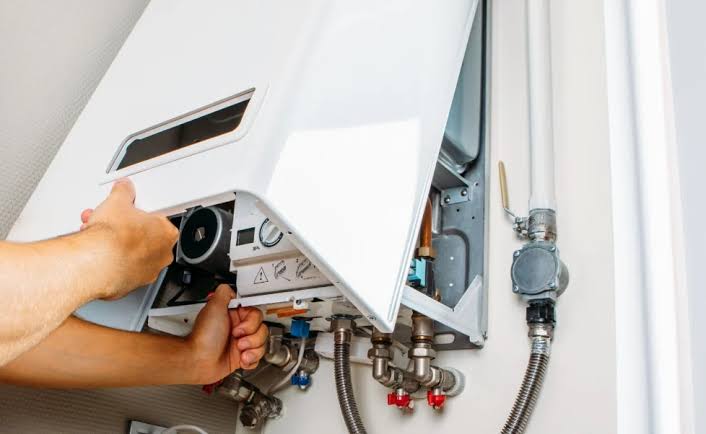
Boilers are almost always replaced in a hurry. Something fails in November, the house is cold, and a decision that will govern the heating and hot water for the next twelve to fifteen years gets made in an afternoon on the basis of whoever can attend soonest.
That urgency costs money — not usually on the price of the boiler, which is fairly consistent across the market, but on the specification. An unsuitable boiler installed onto a dirty system with the wrong controls will cost more to run every year it operates, and will fail earlier than it should.
The decisions worth thinking about are surprisingly few.
Is it actually time?
A well-maintained gas boiler will typically run for ten to fifteen years. Replacement generally makes sense when repair costs start approaching a meaningful fraction of a new installation, when parts become difficult to obtain, or when the unit is an older non-condensing model whose efficiency is far below what is now standard.
The clearer signals are behavioural. A boiler that needs repressurising frequently has a leak or a failing expansion vessel. One that locks out repeatedly, makes banging or kettling noises, or produces hot water that runs lukewarm mid-shower is telling you something. Rising gas bills with no change in usage point the same way.
One thing that is not a reason to replace: radiators that are cold at the bottom, or take an age to warm up. That is usually sludge in the system, and fitting a new boiler onto it without addressing it simply moves the problem onto a new appliance — and will often void the warranty.
Combi, system or heat-only
This is the decision with the longest consequences, and it should be driven by how the household uses hot water rather than by what is cheapest to install.
Combi boilers heat water on demand with no cylinder, which frees up airing cupboard space and avoids storing hot water you may not use. They suit smaller properties and households where the demand for hot water rarely overlaps. Their limitation is flow rate: a combi delivers a fixed number of litres per minute, and running two showers at once will disappoint everyone involved. Flow rate also depends on the incoming mains supply, so a large combi on a weak mains will not perform to its specification.
System boilers work with a pressurised hot water cylinder. They handle multiple simultaneous outlets comfortably, which is why they remain the sensible choice for houses with more than one bathroom. The trade-off is the space the cylinder occupies and the finite volume of stored water.
Heat-only boilers, sometimes called conventional or regular, use a cylinder plus a feed and expansion tank in the loft. They are usually retained where a property has an existing gravity-fed system that would be disruptive to convert, or where the mains pressure is too poor to support a pressurised system.
Converting between types is possible but involves pipework changes, so factor that into any comparison of quotes.
Sizing: the most common error
The instinct is that a bigger boiler must be better. It is not. An oversized boiler cycles on and off repeatedly rather than running steadily, which wastes fuel, increases wear on components, and stops the boiler condensing properly — which is the entire mechanism by which a modern boiler achieves its efficiency.
Correct sizing comes from a heat loss calculation: the property’s dimensions, construction, insulation, glazing and the number of radiators, plus the hot water demand. Any installer who quotes a boiler output without asking those questions has estimated, and the estimate will be generous. Ask what heat loss figure the recommendation is based on.
Controls are where the savings actually are
Since 2018, the Boiler Plus standards in England have required new gas boiler installations to meet a minimum efficiency and to include time and temperature control as standard. For combi installations, one additional efficiency measure is also required — options include weather compensation, load compensation, flue gas heat recovery, or smart controls with automation and optimisation.
These are not box-ticking exercises. Weather compensation adjusts the flow temperature according to outside conditions so the boiler runs cooler and condenses more of the time. Thermostatic radiator valves let you stop heating rooms nobody uses. And simply lowering the flow temperature on a condensing boiler — many are commissioned far higher than they need to be — is one of the few adjustments that reduces bills without reducing comfort.
Ask what flow temperature your system is set to. If the answer is 70°C or above and the house heats adequately, there is efficiency being left on the table.
The system, not just the box
A new boiler is being connected to pipework and radiators that may be decades old and full of corrosion debris. Two things should happen at installation.
The system should be cleaned — typically a power flush or a chemical clean, depending on its condition — to remove the sludge that restricts flow and damages pumps and heat exchangers. And a magnetic filter should be fitted on the return, capturing debris before it reaches the new appliance. Most manufacturers now make both effectively a condition of the warranty, so this is not an optional upsell.
While the system is drained is also the cheapest moment to replace tired radiators or add a valve that has been seized for years.
The paperwork that protects you
Any gas work must be carried out by an engineer on the Gas Safe Register, and you are entitled to ask to see the card, which shows what categories of work they are qualified for. A boiler installation must also be notified to Building Control, which registered installers do through their scheme, and you should receive a Building Regulations compliance certificate afterwards along with the manufacturer’s warranty registration and the commissioning checklist.
Keep all of it. Warranty claims and house sales both require it.
Then service the boiler annually. It maintains the warranty, catches problems while they are small, and includes the combustion checks that protect against carbon monoxide — the one risk in domestic heating that is genuinely serious and entirely undetectable without instruments.
Getting quotes worth comparing
Ask for at least three, and insist each specifies the boiler make, model and output, what controls are included, whether a system clean and filter are in the price, and what the warranty period is. Warranties vary from two years to a decade depending on brand and installer accreditation, and that difference is worth real money.
Firms handling boiler installation in Brentwood and across Essex will generally survey the property before quoting rather than pricing over the phone — and if you are weighing a straight replacement against a longer-term move to a heat pump, that survey is the right moment to have the conversation, because the insulation and radiator sizing implications are considerable.
Finally: if you can possibly manage it, replace the boiler in summer. Engineers have availability, prices are keener, and nobody is making the decision in a cold house.