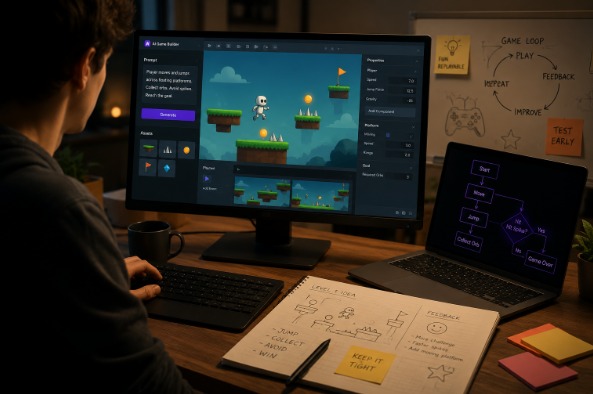
Speed used to be the one thing game development couldn’t offer beginners. Every idea, no matter how simple, had to survive weeks of setup, learning, and manual implementation before it became something playable. That bottleneck is gone now, and understanding exactly how to use that speed well is what separates a genuinely fast process from one that just feels rushed.
Here’s the actual fastest path from an idea in your head to something you can hand someone and say “try this.”
Why Speed Was Never the Real Problem Before
Ideas have always been fast. Writing down a game concept takes minutes. What used to take weeks or months was translating that idea into a working version, learning a language or engine well enough to implement even the simplest mechanic. AI-assisted, no-code tools removed that translation step almost entirely, which means the fastest path to a playable game today has very little to do with technical shortcuts and everything to do with clarity and discipline.
Step One: Compress Your Idea Into One Sentence
Skip the Backstory, Get to the Action
Before anything else, describe the single repeated action your player performs. Not the setting, not the story, just the mechanic. “The player slices through obstacles while managing momentum” is fast to build around. A paragraph of lore isn’t.
Know the Appeal Immediately
A game like Papercut.io works because the core tension is instantly understandable, quick, precise decisions with immediate visual feedback. That clarity is exactly what makes an idea fast to prototype well, since there’s no ambiguity about what the first version needs to test.
Step Two: Generate the Roughest Possible First Version
Skip Art, Skip Sound, Skip Everything Except the Mechanic
Game maker online platforms let you describe your core action in plain language and get a working version back almost immediately. Resist the urge to describe visual details or polish at this stage. The fastest path to playable is asking for exactly the mechanic and nothing else.
Play It the Moment It’s Ready
Don’t adjust before playing. The entire point of speed here is getting real information fast, and that only happens once you’ve actually experienced the rough version yourself.
Step Three: Iterate in Tight, Fast Loops
Change One Thing, Test Immediately
The fastest overall process isn’t the one with the fewest steps, it’s the one where each loop of change-and-test happens quickly and tells you something clear. Adjust a single variable, play again, and repeat.
Don’t Wait for Perfect Feedback to Move Forward
Get a rough reaction from even one other person as early as possible rather than waiting for a polished version to show anyone. Early, rough feedback moves a project forward faster than late, detailed feedback ever does.
Step Four: Know When to Stop Iterating on the Core and Start Polishing
Recognize the Point of Diminishing Returns
Once the core mechanic feels genuinely satisfying, further iteration on it starts producing smaller and smaller improvements. That’s the signal to shift attention toward feel and polish rather than continuing to tweak the same mechanic indefinitely.
Polish Fast Too
Speed doesn’t stop mattering once you’re past the core loop. Tightening feedback, adjusting timing, and refining pacing all benefit from the same fast, iterative approach, small changes, quick tests, rather than long, unfocused polish sessions.
What Actually Slows the Process Down
Overdescribing the Idea Upfront
Long, elaborate descriptions at the generation stage tend to produce vaguer results than short, specific ones. Precision beats detail when speed matters.
Adjusting Multiple Things at Once
It feels efficient to change several elements simultaneously, but it usually costs more time overall, since you can’t tell what actually caused an improvement or a problem, and end up retracing your steps.
Skipping Real Feedback to “Save Time”
Guessing what feels right instead of testing with someone else often feels faster in the moment but usually costs more time later, once assumptions turn out to be wrong.
A Fast, Practical Workflow
- Write your core action in one sentence.
- Generate the roughest possible playable version.
- Play it immediately, without adjusting first.
- Change one variable at a time and retest.
- Get a quick reaction from someone else early.
- Shift to polish once the core loop feels solid.
Final Thoughts
The fastest way to turn an idea into a playable game isn’t about finding a shortcut through the creative work, it’s about removing the technical delay that used to stand between having an idea and testing it. Speed comes from clarity, tight iteration loops, and a willingness to get real feedback early, not from skipping any of the steps that actually make a game good.
Get to something playable fast, then let real play, not assumption, decide what happens next.