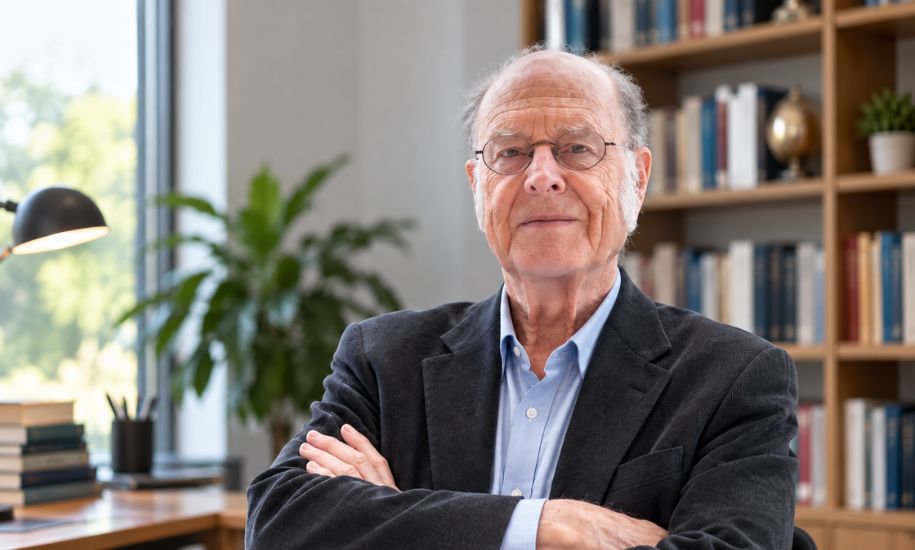
Charles H. Bennett is one of the scientists who helped transform the way researchers think about information, computation and the laws of physics. Over more than five decades at IBM Research, he has made influential contributions to reversible computation, quantum cryptography, quantum teleportation and the broader field of quantum information science. His work with Gilles Brassard helped establish ideas that are now central to quantum communication and quantum computing. In 2026, his long scientific career received another major distinction when he was named a co-recipient of the 2025 ACM A.M. Turing Award.
Quick Bio of Charles H. Bennett
| Detail | Information |
|---|---|
| Full Name | Charles H. Bennett |
| Born | 1943 |
| Birthplace | New York City, United States |
| Profession | Physicist and information theorist |
| Education | Brandeis University; Harvard University |
| Doctorate | PhD in Chemical Physics, Harvard University |
| Institution | IBM Research |
| Known For | Quantum information, cryptography, teleportation and reversible computation |
| Major Collaborator | Gilles Brassard |
| Famous Contribution | BB84 quantum key-distribution protocol |
| IBM Recognition | IBM Fellow |
| Major Recent Honor | 2025 ACM A.M. Turing Award |
| Breakthrough Prize | 2023 Fundamental Physics |
Who Is Charles H. Bennett?
For anyone asking who is Charles H. Bennett, the simplest answer is that he is an American physicist and information theorist whose research helped establish quantum information as a major scientific field.
Bennett joined IBM Research in 1973 and built a career around a fundamental question: how are information and computation connected to the physical world? His research brought together physics, computer science, mathematics and information theory. The Royal Society describes his work as extending classical theories of computation and communication onto a quantum foundation, with important contributions involving quantum cryptography, quantum computing, entanglement and quantum teleportation.
His career is particularly notable because many of his early theoretical questions eventually became connected to technologies being developed today. Ideas that once seemed highly abstract now influence research into secure communications and quantum computers.
Education and Early Scientific Career
Born in New York City in 1943, Bennett grew up in a family connected to music. He studied at Brandeis University before earning a PhD in chemical physics from Harvard University in 1971. His interests gradually moved beyond traditional chemistry toward questions about computation and the physical nature of information.
During his graduate years, he became interested in the relationship between physical processes and computation. That interest would become a defining feature of his scientific career.
In 1973, he joined IBM Research. Rather than treating information simply as an abstract mathematical concept, he investigated information as something governed by physical laws. This perspective eventually became one of the foundations of quantum information science.
Reversible Computation and the Physics of Information
One of Bennett’s important early research areas was reversible computation. Conventional computer operations can erase information, but Bennett investigated whether computation could theoretically be performed in a logically reversible manner.
This work connected computing with thermodynamics and helped deepen scientific understanding of the physical costs associated with information processing.
He also studied the famous Maxwell’s demon problem, which concerns the relationship between information, thermodynamics and entropy. His research helped show why information cannot simply be separated from the physical processes used to store, manipulate and erase it. The Royal Society identifies the thermodynamics of computation, Maxwell’s demon and error correction among his important research contributions.
Charles H. Bennett and Quantum Cryptography
Perhaps the most widely recognized part of Bennett’s work involves quantum cryptography.
Together with Canadian computer scientist Gilles Brassard, Bennett developed the BB84 quantum key-distribution protocol. Introduced in 1984, BB84 provided a way to establish a secret encryption key by taking advantage of fundamental properties of quantum mechanics.
The importance of this approach is that an attempt to observe certain quantum information can disturb the system. That disturbance can therefore provide evidence that an eavesdropper has interfered with the communication.
The work helped establish quantum cryptography as a serious research field. Bennett and Brassard later demonstrated the protocol experimentally, helping move the concept beyond theory. The Breakthrough Prize Foundation credits their BB84 work with initiating quantum cryptography and recognizes it as part of their foundational contributions to quantum information.
Quantum Teleportation and Entanglement
Another landmark contribution came in 1993, when Bennett and collaborators published their influential work on quantum teleportation.
Despite its science-fiction-sounding name, quantum teleportation does not involve transporting people or physical objects instantly. Instead, it provides a method for transferring an unknown quantum state from one location to another by combining shared quantum entanglement with classical communication.
This work helped demonstrate that entanglement could be treated as a practical resource for quantum information processing.
Bennett’s research also contributed to the study of entanglement purification, quantum communication and the capacity of quantum channels. These areas have become important components of modern quantum information theory. The Royal Society lists quantum teleportation, quantitative entanglement theory and the quantum reverse Shannon theorem among his research contributions.
Charles H. Bennett Turing Award Recognition
The Charles H. Bennett Turing Award connection is especially significant for his recent career.
In March 2026, IBM announced that Bennett and Gilles Brassard had been named co-recipients of the 2025 ACM A.M. Turing Award. The award recognized their foundational contributions to quantum information science and their role in establishing ideas that influenced quantum cryptography, quantum computing and entanglement-based technologies.
The award is particularly notable because the 2025 Turing Award was the first Turing Award associated with quantum research. Bennett became the seventh IBM-associated researcher to receive the honor. The prize carried a total value of $1 million, shared by the two laureates.
The recognition reflects how quantum information has developed from a highly theoretical research area into a major field connecting modern physics and computer science.
Other Major Awards and Honors
The Turing Award is only one of several major honors Bennett has received.
He was elected a Foreign Member of the Royal Society in 2022, recognizing his contributions to physics and information theory. He is also a Fellow of the American Physical Society and a member of the U.S. National Academy of Sciences.
In 2023, he shared the Breakthrough Prize in Fundamental Physics with Gilles Brassard, David Deutsch and Peter Shor. The official citation recognized their foundational work in quantum information.
His other distinctions include the ICTP Dirac Medal, the Wolf Prize and the Claude E. Shannon Award, reflecting the breadth of his influence across physics, computing and information theory.
Is Charles H. Bennett a Nobel Prize Winner?
Despite occasional confusion surrounding his many prestigious awards, Charles H. Bennett is not a Nobel Prize laureate.
The confusion is understandable because the ACM A.M. Turing Award is often described as computing’s equivalent of a Nobel-level honor. However, the Turing Award and Nobel Prize are separate awards administered by different organizations.
Bennett’s actual honors include the Turing Award, Breakthrough Prize in Fundamental Physics, Wolf Prize, Dirac Medal and Shannon Award.
Charles H. Bennett’s Legacy in Physics and Computing
The lasting importance of his career comes from the way he connected two disciplines that were once treated quite separately: physics and computation.
His work helped establish the idea that information has physical properties and that quantum mechanics can provide new ways to store, transmit and process information. Quantum cryptography, teleportation and entanglement-based protocols are now established areas of scientific research rather than purely theoretical curiosities.
There is also an important distinction between Charles H. Bennett and other scientists with similar names. In particular, he should not be confused with Charles L. Bennett, the astrophysicist associated with NASA’s Wilkinson Microwave Anisotropy Probe.
Final Thoughts
Charles H. Bennett’s career illustrates how fundamental scientific questions can eventually reshape entire technological fields. From reversible computation and thermodynamics to quantum cryptography and teleportation, his research has influenced how scientists understand the relationship between information and the physical universe. His recognition with the 2025 ACM A.M. Turing Award in 2026 adds another major chapter to a career that has already helped define modern quantum information science. For readers interested in influential scientists, quantum technology and the history of computing, his story remains an important one to explore. At Insider Newz, we continue to cover the people and ideas shaping science, technology and the wider world.