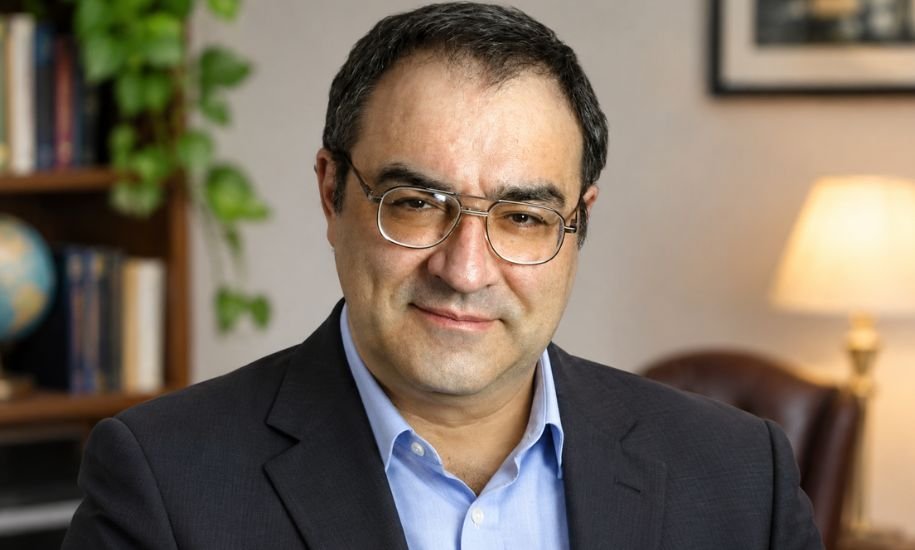
Leonid Khachiyan was a brilliant mathematician and computer scientist whose groundbreaking research changed the way researchers understand mathematical optimization. Best known for developing the ellipsoid method, he made a significant contribution to computational mathematics and theoretical computer science. His achievements earned him international recognition and established his place among the influential mathematical thinkers of the twentieth century. Beyond his academic accomplishments, his personal life has also attracted interest because of his family, including his daughters Anna Khachiyan and Nina Khachiyan, and his wife, Olga Pischikova Reynberg. His story combines intellectual achievement, an international academic journey, and a lasting scientific legacy.
Quick Bio of Leonid Khachiyan
| Detail | Information |
|---|---|
| Full Name | Leonid Genrikhovich Khachiyan |
| Known As | Leonid Khachiyan |
| Date of Birth | May 3, 1952 |
| Birthplace | Leningrad, Soviet Union |
| Nationality | Soviet-American |
| Profession | Mathematician and Computer Scientist |
| Education | Moscow Institute of Physics and Technology |
| Famous For | Ellipsoid Method |
| Wife | Olga Pischikova Reynberg |
| Children | Anna Khachiyan and Nina Khachiyan |
| University Career | Rutgers University |
| Major Award | Fulkerson Prize |
| Date of Death | April 29, 2005 |
| Age at Death | 52 Years |
Who Is Leonid Khachiyan?
Leonid Genrikhovich Khachiyan was a Soviet-born American mathematician whose research helped establish an important theoretical foundation for solving linear programming problems efficiently. He became internationally recognized after demonstrating that linear programming could be solved in polynomial time using the ellipsoid method.
His research was particularly significant because linear programming is widely used in economics, engineering, business management, transportation, and scientific research. The ability to solve these problems efficiently has practical implications for countless industries.
Khachiyan worked as a professor of computer science at Rutgers University in New Jersey. His academic career included research in computational mathematics, optimization, and algorithm design.
Although his life ended relatively early, his research continues to influence mathematical optimization and theoretical computer science.
Early Life and Family Background
Leonid Khachiyan was born on May 3, 1952, in Leningrad, Soviet Union, now known as Saint Petersburg, Russia. He came from an Armenian family with a strong academic and scientific background.
His father, Genrikh Borisovich Khachiyan, was a mathematician and professor of theoretical mechanics. His mother, Zhanna Saakovna Khachiyan, worked as a civil engineer.
Growing up in a family connected to mathematics and engineering provided him with an intellectually stimulating environment. His parents’ professional backgrounds helped expose him to scientific thinking from an early age.
When he was nine years old, his family moved from Leningrad to Moscow. The move introduced him to new educational opportunities and helped shape his academic development.
He demonstrated a strong interest in mathematics during his early years. His natural curiosity and analytical abilities eventually led him toward advanced studies in computational mathematics.
His early experiences laid the foundation for a career that would eventually make him internationally respected in the scientific community.
Education and Academic Development
Khachiyan pursued his higher education at the Moscow Institute of Physics and Technology, one of the Soviet Union’s leading institutions for mathematics, physics, and engineering.
He developed a strong foundation in mathematical theory and computational techniques. His academic interests increasingly focused on algorithms and optimization problems.
After completing his studies, he continued his research at the Computing Center of the USSR Academy of Sciences.
He earned a Ph.D. in computational mathematics in 1978 and later obtained a Doctor of Science degree in computer science in 1984.
His academic research explored how mathematical problems could be solved through efficient computational methods.
This combination of mathematical theory and computer science became central to his later achievements, particularly his work on the ellipsoid method.
The Ellipsoid Method: His Greatest Contribution
One of the most important achievements in his career was the development of the ellipsoid method, an algorithm that transformed the theoretical understanding of linear programming.
Linear programming is a mathematical technique used to find the best possible solution while satisfying a set of constraints. For example, a manufacturing company might use linear programming to determine how many products it should produce to maximize profit while minimizing costs.
Before Khachiyan’s breakthrough, researchers had developed several methods for solving linear programming problems. However, an important theoretical question remained: Could these problems be solved in polynomial time?
In 1979, Khachiyan demonstrated that the answer was yes.
His ellipsoid method showed that linear programming problems could be solved within a number of computational steps bounded by a polynomial function of the input size. This was a major development in computational complexity theory.
The algorithm works by repeatedly constructing and reducing ellipsoids around the possible solution region. Each iteration helps narrow the search toward a feasible solution.
Although the ellipsoid method was not always faster than existing practical algorithms, its theoretical importance was enormous. It established a foundation for future research in optimization and influenced the development of other algorithms.
His work eventually earned him the Fulkerson Prize in 1982, recognizing his outstanding contribution to mathematical programming.
Career at Rutgers University
Khachiyan began his professional career at the Computing Center of the USSR Academy of Sciences, where he conducted research in computational mathematics.
He also worked at the Moscow Institute of Physics and Technology, contributing to academic research and mathematical development.
In 1989, he moved to the United States and became a visiting professor at Cornell University’s School of Operations Research and Industrial Engineering.
The following year, he joined Rutgers University in New Jersey as a professor of computer science.
At Rutgers, he continued exploring optimization theory, mathematical algorithms, and computational complexity. His work contributed to the university’s reputation in theoretical computer science.
He was respected by colleagues for his intellectual abilities, modest personality, and dedication to research.
His academic career in the United States allowed him to collaborate with researchers from different backgrounds and contribute to the international scientific community.
Leonid Khachiyan’s Wife: Olga Pischikova Reynberg
Leonid Khachiyan was married to Olga Pischikova Reynberg. The couple married in 1985 and had two daughters, Anna and Nina.
Olga Pischikova Reynberg is primarily known through her connection to the mathematician and their family. Publicly available information about her personal and professional background remains limited.
The family eventually settled in the United States, where Khachiyan continued his academic career.
While his professional achievements brought him international recognition, his family remained an important part of his personal life.
His daughters later developed their own lives and interests, with Anna becoming particularly well known in American cultural commentary.
Anna Khachiyan and Nina Khachiyan
Leonid Khachiyan’s daughters, Anna Khachiyan and Nina Khachiyan, have attracted attention because of their father’s remarkable academic legacy.
Anna Khachiyan
Anna Khachiyan is a Russian-born American writer, cultural critic, and podcaster. She is best known as the co-host of the Red Scare podcast, which she launched with Dasha Nekrasova in 2018.
Born in Moscow in 1985, Anna later grew up in New Jersey after her family moved to the United States.
She attended Rutgers University and New York University and developed a career in cultural commentary, writing, and podcasting.
Her public career differs considerably from her father’s scientific profession. Nevertheless, their family connection has become an interesting aspect of her biography.
Nina Khachiyan
Nina Khachiyan is Leonid’s second daughter. Compared with Anna, Nina has maintained a relatively private public profile.
Available biographical accounts identify her as one of Leonid Khachiyan’s two daughters. However, detailed information about her education, occupation, and personal life is limited.
It is important to distinguish confirmed family information from speculation when discussing Nina Khachiyan. Her father’s scientific accomplishments and Anna’s public career should not be used to make unsupported assumptions about Nina’s own professional or personal circumstances.
Awards and Recognition
Leonid Khachiyan received significant recognition for his contribution to mathematical programming.
His most notable distinction was the Fulkerson Prize, awarded in 1982 by the Mathematical Programming Society and the American Mathematical Society.
The award recognized his groundbreaking research demonstrating the polynomial-time solvability of linear programming.
His work became an important milestone in theoretical computer science and mathematical optimization.
Researchers continue to study his ideas because they provide valuable insights into algorithmic efficiency, computational complexity, and mathematical problem-solving.
His influence extends beyond a single algorithm, contributing to the broader understanding of how complex mathematical problems can be approached computationally.
Leonid Khachiyan’s Death and Lasting Legacy
Leonid Khachiyan died on April 29, 2005, in South Brunswick, New Jersey, following a heart attack. He was 52 years old and passed away just days before his 53rd birthday.
His death was a significant loss for the mathematics and computer science communities.
Colleagues remembered him as an exceptionally talented researcher who combined intellectual brilliance with a modest and thoughtful personality.
His legacy remains closely connected to the ellipsoid method and its role in establishing the theoretical foundations of efficient linear programming.
Although the algorithm itself was not always the most practical solution for real-world optimization problems, its theoretical breakthrough influenced generations of researchers.
His life demonstrates how a single mathematical discovery can reshape the understanding of an entire field.
Leonid Khachiyan remains an important figure in computational mathematics, and his contributions continue to be recognized by researchers and academic institutions worldwide.
For readers interested in mathematics, scientific discoveries, and the lives of influential thinkers, his biography offers an inspiring example of intellectual dedication. At Insider Newz, we explore the lives, achievements, and personal stories of remarkable individuals whose work continues to influence the world.