How AI Can Automate Healthcare Claims Processing Without Replacing Existing Systems

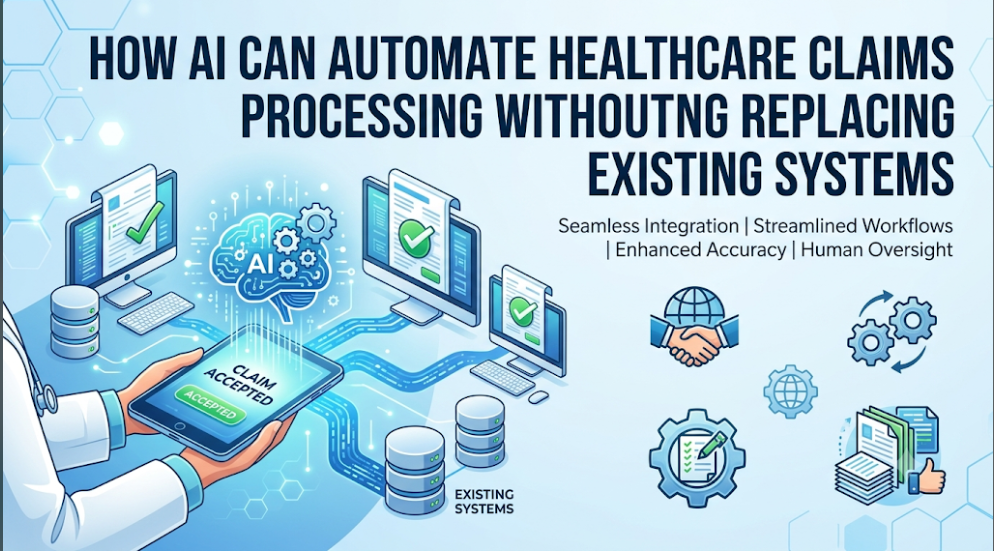
Healthcare claims processing remains one of the most labor-intensive operations inside any hospital, clinic, or payer organization, and it is often the first place executives look when they hear about AI.
The usual assumption is that automating claims means ripping out the claims management system, the EHR, or the clearinghouse that took years to configure.
That assumption is false. AI can strengthen the systems already in place instead of replacing them, and the rest of this guide explains exactly how that works in practice.
Why Claims Processing Is Still So Manual (The Problem)
Most healthcare organizations still run claims through a heavily manual pipeline, and the reasons are structural rather than a lack of effort from staff. A mid-sized hospital system might generate tens of thousands of claims a month, while the billing team assigned to review, correct, and submit them stays roughly the same size year over year. That mismatch between claim volume and staff capacity means backlogs build up quietly until they show up as delayed reimbursements.
Denial and rework rates make the problem worse. A single claim can bounce back from a payer because of a missing modifier, an outdated CPT code, or a mismatch between the diagnosis and the procedure billed. When that happens, a biller has to pull the claim, research the reason for denial, correct it, and resubmit it, often days or weeks after the original service was delivered. Multiply that by hundreds of denials a month and the rework alone can consume a large share of a billing department’s time.
Data entry errors and inconsistent coding sit underneath most of those denials. A coder working under pressure might enter ICD-10 code E11.9 for a general diabetes diagnosis when the documentation actually supports a more specific code tied to a complication, and that small inconsistency is enough for a payer’s automated edit checks to reject the claim outright. These errors are rarely dramatic, but they are frequent enough to create a steady drag on approval rates.
Slow turnaround times are the visible symptom of everything above. When claims sit in a manual review queue for a week or two before submission, and then wait again for payer adjudication, the gap between service delivery and payment stretches out. That delay affects a provider’s cash flow directly, and it also affects patient satisfaction when billing statements arrive late or contain errors that patients then have to dispute.
Compliance risk grows out of the same manual gaps. When claims are reviewed by hand under time pressure, documentation of medical necessity, coding justification, and audit trails can end up incomplete. During a payer audit or a compliance review, those gaps become liabilities, and organizations already working with a healthcare claims management platform often find that the software itself is not the bottleneck. The manual review layered on top of it is.
The Core Doubt: “Will AI Replace Our Existing Systems?”
This is the question that stops most healthcare claims automation projects before they start, and it deserves a direct answer. No, AI does not require replacing the claims management system, the EHR, or the clearinghouse an organization already relies on. The confusion usually comes from conflating two very different things: replacing infrastructure and adding an intelligence layer on top of it.
Replacing infrastructure means migrating years of claims history, retraining every user, and re-establishing every payer connection from scratch, which is exactly the kind of disruptive project healthcare IT teams try to avoid. Adding an intelligence layer means something much narrower.
AI models sit alongside the existing system, read the same claims data through an integration, apply rules or predictions to that data, and hand results back to staff or to the system itself. The claims management system keeps doing what it already does well: storing records, managing workflows, and connecting to payers. The AI layer simply makes the decisions and flags inside that workflow smarter and faster.
Where AI Actually Fits in the Claims Workflow
Before a claim is even submitted, AI can run automated eligibility checks against payer data, validate that the codes on the claim match the documentation, and flag likely errors so a biller catches them before submission rather than after a denial. This pre-submission layer sits on top of the existing claims system rather than replacing the intake process staff already use.
Once a claim moves into processing, AI can triage it by complexity, routing straightforward, low-risk claims toward auto-adjudication while sending anything unusual or high-value to a human reviewer. A routine wellness visit claim with no complicating factors can move through this path in minutes, while a claim involving multiple procedures and modifiers still lands on a biller’s desk for review, which keeps human judgment in the loop where it matters most.
After a claim has been submitted, AI shows real value in denial prediction and pattern detection. By learning from thousands of past denials, a model can flag a new claim as high risk for rejection before the payer even responds, and in some workflows it can draft the appeal letter for a denied claim automatically, pulling in the relevant clinical documentation so a biller only has to review and send it rather than write it from scratch. This is one of the areas where AI in medical billing has moved from experimental to genuinely useful for revenue cycle teams.
Reconciliation is the last stage where AI adds real leverage. Matching incoming payments against submitted claims, flagging underpayments, and spotting discrepancies between what was billed and what was paid are all pattern-matching tasks that AI handles faster and more consistently than a manual spreadsheet review, again without changing the accounting or claims system underneath it.
How AI Integrates With Legacy and Existing Systems
Integration almost always happens through APIs rather than through a system swap. A claims automation vendor connects to the existing claims management system, EHR, or clearinghouse through its existing interfaces, reads and writes data through that connection, and never touches the underlying database directly. This is the same pattern used across most modern healthcare software integrations, and it is why organizations investing in EHR integration services can add AI-driven claims features without a rip-and-replace migration.
Working with existing platforms rather than migrating off them matters most for organizations running systems that have been customized over years, sometimes decades. A hospital that built extensive custom workflows into its claims platform is not going to abandon that investment for an AI vendor, and reputable vendors know this. They design their integrations to sit on top of legacy infrastructure, which is also why healthcare legacy system modernization increasingly means adding modern capabilities in layers instead of forcing a full rebuild.
Human-in-the-loop design is the safeguard that makes this approach trustworthy for compliance-sensitive work. AI flags a claim as likely to be denied, suggests a coding correction, or drafts an appeal, but a staff member still reviews and approves anything that falls outside routine, low-risk cases. This keeps accountability with the people who are trained and licensed to make clinical and billing judgment calls, while removing the repetitive work that used to consume most of their day.
IT and compliance concerns about disruption are usually the biggest internal barrier, and they are addressed the same way any API-based integration is addressed: through a sandbox environment, a phased rollout, and audit logging that tracks every action the AI layer takes. None of this requires downtime for the core claims system, and most implementations run in parallel with existing manual processes until the automation has proven itself on real claims.
The Business Case for Decision-Makers
Reduced denial rates and faster reimbursement cycles are the most immediate return most organizations see. When AI catches coding errors and eligibility mismatches before submission, fewer claims bounce back, and the ones that do get flagged for appeal faster because the pattern was already predicted. A billing team that used to spend a third of its time on rework can redirect that capacity toward higher-value work.
Lower administrative overhead follows directly from that shift. Staff spend less time on repetitive data entry and manual eligibility checks, which either reduces the need to keep hiring additional billing staff as claim volume grows, or frees existing staff to focus on complex cases and payer negotiations. Teams supporting revenue cycle management consistently point to this as the clearest financial argument for AI-assisted claims processing.
Improved accuracy and compliance audit trails come from the fact that AI systems log every decision and flag they generate, which creates a far more complete record than a manual review process typically produces. When a payer or regulator asks why a claim was submitted a certain way, that documentation already exists rather than needing to be reconstructed after the fact.
Better cash flow predictability rounds out the business case. When denial rates drop and turnaround times shorten, the gap between delivering care and receiving payment becomes more consistent, which makes revenue forecasting meaningfully more reliable for finance teams who previously had to plan around wide swings in reimbursement timing.
Common Doubts and Objections, Addressed
Will this disrupt our current staff workflows? Not if the rollout is designed correctly. AI tools are typically introduced as an added step inside the existing workflow, flagging issues or suggesting actions inside the same interface staff already use, rather than forcing them to learn an entirely new system on day one.
What happens to our existing investment in claims software? It stays exactly where it is. The AI layer works with that software through an integration, so the licensing, configuration, and institutional knowledge built up around the existing platform remain fully intact and useful.
How do we maintain compliance and audit trails with AI in the loop? Every recommendation, flag, and automated action the AI takes should be logged with a timestamp and a clear rationale, which in practice gives compliance teams a more detailed audit trail than most manual processes ever produce.
What is the realistic implementation timeline? A narrow, well-scoped pilot, such as automating eligibility verification for one department, typically takes a few weeks to configure and test. Expanding that pilot across the full claims workflow is a longer process, usually spread across several months, and it should be paced deliberately rather than rushed.
Can AI actually handle claims accuracy, or will it create new errors? AI is very good at pattern recognition across large volumes of historical claims data, which makes it reliable for flagging likely errors and predicting denials. It is not designed to replace human judgment on ambiguous or disputed claims, and a well-built system routes those cases to a human reviewer rather than trying to resolve them on its own.
What Implementation Actually Looks Like
The first real step is assessing the current claims workflow to identify which parts are genuinely automation-ready. This usually means mapping out every stage from eligibility check through payment reconciliation and marking which steps are repetitive, rules-based, and high-volume, since those are the steps where AI adds value fastest.
From there, most successful rollouts start with a narrow, high-volume use case rather than trying to automate the entire workflow at once. Eligibility verification and denial prediction are common starting points because they are self-contained, measurable, and low-risk if something needs adjustment early on.
Integration planning comes next, and it should be treated as a technical project scoped around the existing systems rather than a full overhaul. This is where IT teams map out exactly which APIs the claims platform and EHR expose, what data needs to flow in each direction, and how the AI layer will authenticate and log its activity.
Staff training and change management often get underestimated, but they determine whether the automation actually gets used. Billers and coders need to understand what the AI is flagging and why, how to override a suggestion when their judgment differs, and how their role shifts from manual data entry toward reviewing exceptions and handling more complex cases.
Risks and Limitations to Be Realistic About
AI is only as good as the data it is trained on, and healthcare claims data is often messy, inconsistent across departments, or incomplete in ways that are not obvious until the model starts producing unreliable flags. Organizations should expect a data cleanup phase before any automation project, not after problems show up in production.
It is not a substitute for human judgment on complex or disputed claims. Cases involving unusual procedure combinations, disputed medical necessity, or appeals that require clinical nuance still need an experienced biller or coder making the final call, and any vendor who claims otherwise should be treated with skepticism.
Integration effort is still required, even when it is far lighter than a full system replacement. Connecting an AI layer to existing systems takes real engineering time, testing, and validation, and organizations should budget for that work rather than assuming it happens automatically.
Vendor lock-in and long-term maintenance deserve attention before signing a contract. Some AI vendors claim to build their tools around proprietary data formats that are difficult to migrate away from later, so it is worth asking upfront how portable the data and configurations are if the organization ever needs to switch providers, especially as the broader healthcare automation market continues to shift and new vendors enter the space.
How to Get Started (Practical Next Steps)
Before evaluating any AI claims automation partner, it is worth asking a short list of pointed questions: how does the tool integrate with our specific claims and EHR platforms, what does the audit trail look like, how is staff training handled, and what happens to our data if we end the contract? Vendors who answer these clearly and specifically, and who can point to real experience among healthcare claims management software development companies, are usually the ones worth pursuing further.
Picking a low-risk pilot area matters more than picking an ambitious one. Eligibility verification, denial prediction, or payment reconciliation are all good starting points because they touch a contained slice of the workflow, produce measurable results quickly, and do not put high-stakes claims decisions in the hands of an unproven system.
What success should look like in the first 90 days is worth defining before the pilot even starts. A reasonable target might be a measurable drop in denial rates for the pilot claim type, a documented reduction in manual review time, and a clean audit trail that compliance can review, all achieved without disrupting the existing claims platform staff already rely on.
Conclusion
Healthcare claims processing does not have to mean choosing between the systems an organization has already invested in and the efficiency gains AI can offer.
The two work together when AI is treated as an added intelligence layer rather than a replacement project, giving billing teams faster turnaround, fewer denials, and a stronger audit trail without tearing out infrastructure that already works.
Organizations can also develop a healthcare app to extend these capabilities across claims workflows, improving accessibility and automation without replacing their existing systems.