Usually after the third or fourth incident, the conversation around Digital Risk Protection shifts. Not dramatically. Just enough. Security teams stop asking what tool to buy and start asking why threats keep appearing outside their field of view.
That is where digital risk protection platforms begin to feel less like an optional layer and more like a necessary extension of visibility. The idea itself is not complicated. The execution rarely stays that way.
The Exposure Problem
Most organisations have a reasonable grip on what sits inside their network. Endpoints, identities, access policies. Even cloud workloads are now better tracked than they were a few years ago.
What remains unclear is everything else. Domains registered in similar names. Credentials circulating in forums. Fake mobile apps. Executive impersonation accounts. Fragments of data stitched together across platforms that were never meant to be connected.
None of this lives neatly within traditional security boundaries. Which means it often goes unnoticed until it becomes someone else’s problem to fix. Digital risk protection platforms sit in that gap. They are designed to observe what is happening beyond controlled environments. Quietly, and often continuously.
What These Platforms Actually Do
There is a tendency to describe these systems in feature lists. Monitoring, detection, response. That framing misses the point.
The real function of digital risk protection platforms is correlation. They connect weak signals across scattered sources and present them in a way that allows action before escalation. Some of the more mature platforms focus on a few consistent areas:
- External Threat Intelligence
This includes dark web monitoring, credential leaks and discussions that hint at planned attacks. Not all of it is useful. The value lies in filtering what matters.
- Brand and Impersonation Detection
Fake domains, social media profiles, and phishing campaigns targeting customers or employees.
- Attack Surface Discovery
Unmanaged assets, exposed services, forgotten infrastructure. These are often the easiest way in.
- Data Leakage Tracking
Sensitive data appearing where it should not. Sometimes intentional, often accidental.
The technology itself is not the differentiator anymore but the coverage is.
Signals, Not Alerts
Security teams already deal with too many alerts. Adding another stream rarely helps.
The better digital risk protection platforms avoid this by prioritising context over volume. Instead of flagging every mention of a company name, they look for patterns.
A credential leak becomes more relevant when paired with login attempts from unusual regions. A newly registered domain matters more when it mirrors an active campaign.
This sounds obvious. It is not always implemented well. There have been cases where organisations subscribed to multiple intelligence feeds yet missed early signs of targeted phishing because the signals were never connected. The problem was lack of interpretation.
Where Implementation Tends to Fail
The challenges are rarely technical. One common issue is ownership. External risk does not sit cleanly within any one team. Security, brand protection, legal, fraud prevention. Each sees part of the picture.
Without alignment, digital risk protection platforms end up underused. Alerts get routed, acknowledged, and quietly ignored.
Another issue is expectation. These platforms do not eliminate risk. They reduce uncertainty. Organisations expecting immediate prevention often end up disappointed.
There is also the question of response. Detection without a clear action path creates friction. If a fake domain is found, who takes it down. If credentials are exposed, how quickly can they be rotated. The platform can highlight the issue. It cannot resolve organisational gaps.
How The Workflow Should Look
Before diving into the mechanics, it helps to visualise how an effective process unfolds.
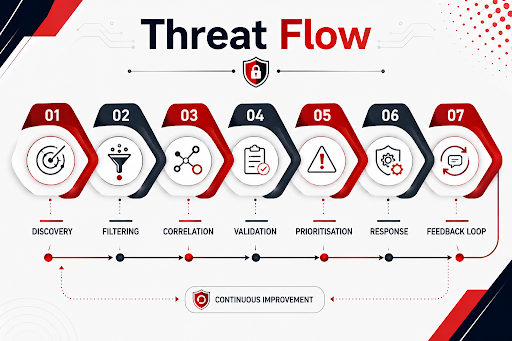
A basic model for how digital risk protection platforms operate in a working environment:
- Discovery
External sources are continuously scanned for indicators. This includes forums, marketplaces, domain registrations, and social platforms.
- Filtering
Noise is reduced through relevance scoring. Not every mention becomes a case.
- Correlation
Signals are connected across sources. Patterns begin to form.
- Validation
Findings are assessed for credibility and impact. False positives are removed.
- Prioritisation
Risks are ranked based on potential damage and immediacy.
- Response
Actions are triggered. This may involve takedowns, credential resets, or internal escalation.
- Feedback Loop
Outcomes are fed back into the system to refine detection accuracy.
This flow is where many deployments struggle. Not because the steps are unclear, but because the transitions between them are rarely smooth.
The Quiet Shift in Threat Behaviour
Over the past few years, attackers have moved towards softer entry points. Less reliance on direct exploitation. More focus on manipulation, exposure and timing.
Credential reuse remains one of the most effective techniques. Not because systems are weak, but because users are predictable.
Similarly, brand impersonation has grown steadily. Fake investment apps, cloned websites, social media scams. These attacks do not break defences. They bypass them entirely.
Digital risk protection platforms have evolved in response to this shift. They are less concerned with blocking traffic and more focused on identifying intent. That distinction matters.
Not All Platforms Are Equal
There is a visible gap between vendors who collect data and those who understand it.
Some platforms cast a wide net but offer limited analysis. Others focus on depth, providing fewer alerts but richer context. Choosing between them depends on organisational maturity.
Teams with strong internal analysis capabilities may prefer broader data collection. Those with limited resources often benefit from curated intelligence.
Either way, integration becomes critical. Without alignment with existing workflows, even the most capable digital risk protection platforms become another isolated tool.
Measuring Value Without Oversimplifying
It is tempting to measure success through numbers. Alerts generated, threats detected, incidents prevented. These metrics only tell part of the story.
The real value often appears in what does not happen. A phishing campaign stopped early. A leaked credential rotated before misuse. A fraudulent domain taken down before gaining traction. These outcomes are harder to quantify. They are also the reason these platforms exist.
The line between internal and external risk continues to blur.
Cloud adoption, remote work, and digital ecosystems have extended organisational boundaries beyond recognition. Security models are adjusting, but slowly.
Digital risk protection platforms are becoming part of that adjustment. Not as standalone solutions, but as connectors between scattered risk signals.
There is also a gradual move towards automation. Not full autonomy, but assisted response. Faster takedowns, quicker validation, reduced manual effort. Even so, human judgement remains central. Context cannot yet be fully automated.
Conclusion
Digital risk protection platforms are not a replacement for existing controls. They sit alongside them, extending visibility into areas that were previously ignored or misunderstood.
Their effectiveness depends less on technology and more on how they are used. Alignment, ownership, and response capability matter more than feature depth.
CyberNX can help you by uncovering threats at the source to disrupt abuse before it reaches business or the public eye. They combine intelligence, technology & human expertise to protect enterprises from fast-moving external digital threats. Their DRP services are designed for regulated, consumer-facing & high-trust industries where brand misuse causes immediate harm.