Automated Photo Technology: The Complete Guide to Faster, Smarter, and More Profitable Photography

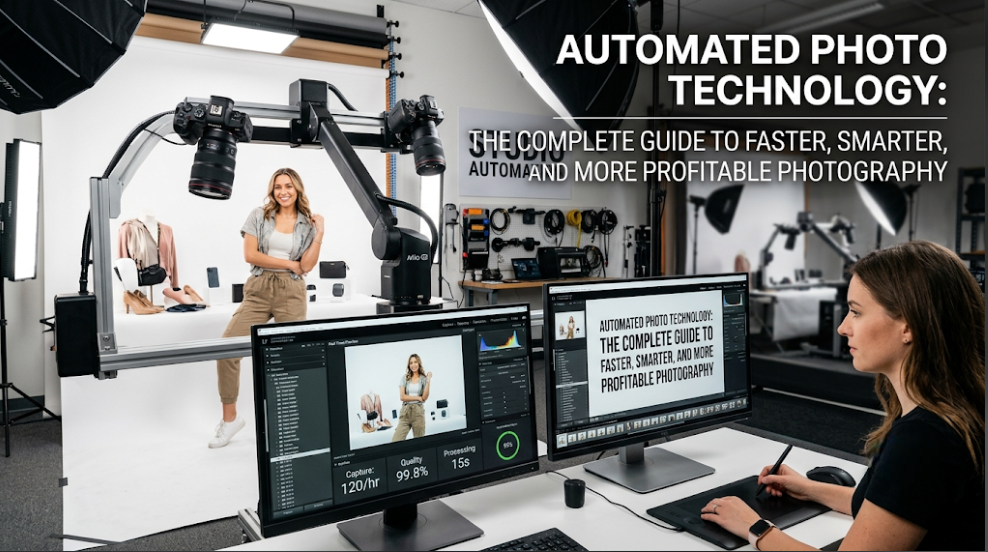
If you are a real estate photographer or agent shooting 3 listings a day, the smartest business decision you can make is to partner with a professional real estate photo editing company that is built on automated photo technology.
If you shot real estate photos ten years ago, you remember the grind.
You come back from a shoot with 300 RAW files. You dump them on your laptop at 11 PM. Then starts the real work – straightening verticals, pulling up shadows, making that dull sky blue again, cloning out the trash bin in the driveway, adding a warm fire to a cold fireplace. Three hours later, you’ve finished maybe one property.
Today, that same job can be done in minutes, while you sleep.
That’s the power of automated photo technology. And if you’re a photographer, a real estate agent, or run a studio, it’s not just changing how you edit – it’s changing your entire business model.
What Exactly Is Automated Photo Technology?
Let’s keep it simple. Automated photo technology is the use of artificial intelligence, machine learning, and computer vision to perform photography tasks that humans used to do manually.
It’s not one tool. It’s an entire ecosystem.
Think of it in three layers:
1. Automated Capture: Cameras and drones that can auto-bracket exposures, detect rooms, and even guide a beginner to shoot like a pro. Some 360 cameras now automatically align and stitch images.
2. Automated Culling and Organization: Software that can look through 2,000 photos from a wedding or a real estate shoot and instantly pick the sharpest, best-exposed, best-composed shots. No more scrolling for hours.
3. Automated Editing and Enhancement: This is where the revolution is happening. The software learns what a “good” image looks like – perfect white balance, bright but natural windows, straight walls, vibrant grass – and then applies those corrections to hundreds of images at once.
For a long time, editing meant presets. A preset is dumb. It applies the exact same settings to every photo, whether it needs it or not. Automated photo technology is smart. It actually sees the image. It knows the difference between a living room and a bathroom. It knows when a window is blown out and needs to be pulled back. It knows where the sky is.
From Darkroom Chemicals to Deep Learning: A Quick Evolution
Photography has always chased automation.
In the 1900s, the darkroom was fully manual. Every dodge and burn was done by hand. Then came Photoshop in 1990. Suddenly you could undo. Then came Lightroom and batch processing. You could sync settings across 500 images.
But you were still the decision-maker for every single slider.
Around 2017-2018, things shifted. Companies started training AI models on millions of professionally edited photos. Instead of telling the computer “increase brightness by +20,” they showed it 10,000 before-and-after examples of good real estate photos. The AI learned the pattern itself.
That’s machine learning. And when you combine it with computer vision – the ability for a computer to actually identify objects like “sky,” “grass,” “sofa,” “window” – you get something magical.
Early automation was clunky. Sky replacements looked fake. Skin tones turned orange. But the models kept learning. By 2023-2024, automated editing became not just fast, but actually good. Good enough that even professional retouchers couldn’t tell the difference in a blind test for standard corrections.
And now in 2026, we’re in the third wave. It’s not just about correction anymore. It’s about creation – virtual staging, virtual twilight, automatic decluttering, day-to-night conversions – all happening with one click.
How Does Automated Photo Technology Actually Work Under The Hood?
You don’t need a PhD to use it, but understanding how it works helps you trust it.
Step 1: Image Analysis with Computer Vision
The second you upload an image, the AI segments it. It creates an invisible map. This area is sky. This is wall. This is floor. This is a window. This is overexposed. For real estate, this is critical because a living room needs very different treatment than the sky outside the window.
Step 2: Pattern Recognition from Millions of Edits
The AI has been trained on huge datasets of professionally edited images. It knows that real estate clients want bright, airy images with white balance around 5500-6500K, vertical lines perfectly straight, and shadows opened up by about 40-60%. It knows that grass should be green, not yellow, but not neon either.
Step 3: Intelligent Correction Engine
Instead of applying a global filter, it applies localized corrections. It will:
Correct lens distortion and straighten verticals automatically using keystone correction
Balance HDR by blending bracketed exposures without that fake, halos-look
Replace a dull white sky with a blue sky with natural clouds, and it will correctly reflect that blue light inside the room near the window
Enhance the lawn, make the water in the pool more blue, add fire to fireplace
Remove noise, sharpen, and upscale resolution
Step 4: Continuous Learning Loop
The best systems have a human-in-the-loop. When a professional retoucher makes a final tweak, that tweak goes back into the model. The AI gets better every single day.
This is why modern automation is so much better than the “auto-enhance” button on your phone. Your phone guesses. Professional automated technology knows.
Where Automated Photo Technology Is Being Used Right Now
While real estate is leading the charge, this tech is everywhere:
1. E-commerce and Product Photography: Companies like Amazon sellers shoot 1000 products a day. An AI ecommerce tool can automatically remove backgrounds, center the product, correct color to match the real item, and create shadows. What took 5 minutes per image now takes 5 seconds.
2. Portrait and Wedding Photography: AI culling tools like AfterShoot and Imagenomic sort thousands of images, detect closed eyes, and then edit in the photographer’s personal style by learning from their previous Lightroom catalogs.
3. Automotive Photography: Dealerships shoot cars in a small lot with bad lighting. Facebook SMM panel AI automatically replaces the background with a professional showroom, fixes reflections on the windshield, and adds a perfect shadow under the car.
4. And The Biggest Winner: Real Estate Photography
Real estate is the perfect storm for automation. Why? High volume, tight deadlines (listings need to go live in 24 hours), repetitive editing tasks, and a very clear definition of what a “good” photo looks like.
A real estate photographer doesn’t want to be creative with every single image. The agent wants consistency. Bright. Clean. Spacious. Inviting. That’s a recipe an AI can learn perfectly.
According to industry data, a professional real estate editor spends an average of 8-12 minutes per image for a full edit including sky replacement and window pull. With automation, that initial edit drops to under 60 seconds, with a human doing final QC.
That’s not just time saved. That’s money.
The Real Cost of Manual Editing (And Why Automation Makes Business Sense)
Let’s do some real math.
If you shoot 3 houses a day, that’s about 75 final images. At 10 minutes per image manually, that’s 12.5 hours of editing. You are either not sleeping, or you are paying an editor.
If you pay an editor $0.80-$2.00 per image, that’s $60-$150 per shoot just for editing. Your profit margin disappears.
With automated photo technology, your cost per image drops to $0.20-$0.50 for most standard edits, and turnaround goes from 24-48 hours to 2-6 hours. You can shoot more, deliver faster, and agents love you because their listings go live the same day.
But speed is only half the story. Consistency is the other half. When you have three different editors working on your photos, one makes grass too green, one leaves walls too warm, one forgets to straighten. Automation gives you the same perfect look on image 1 and image 1000. That consistency builds your brand.
The Limitations: What Automation Still Can’t Do Well
Let’s be honest. Automation is not magic, and anyone who says you can fire all your editors tomorrow is lying.
1. Complex Object Removal: AI is great at removing a small trash can. It struggles with removing a huge pickup truck that is reflecting in the window and casting a shadow. That still needs a human Photoshop expert.
2. Taste and Intent: AI knows what a “generally good” image looks like. It doesn’t know that this particular luxury listing wants a moody, darker, evening vibe, not a bright and airy look. Creative direction still needs a human.
3. Garbage In, Garbage Out: If you shoot a dark, blurry, crooked photo, automation will make it a brighter, blurry, crooked photo. It can’t fix terrible photography. It amplifies good photography.
This is why the best companies in 2026 don’t sell “100% AI editing.” They sell “AI-powered, human-perfected editing.” The AI does 80-90% of the heavy lifting, and a trained human retoucher does the final 10% quality check. That hybrid model is unbeatable.
How to Choose the Right Automated Photo Editing Partner
Not all automated services are created equal. If you are a photographer or agent looking to outsource, here’s what to check:
Look for Specialization: A company that edits weddings, products, jewelry, AND real estate is a master of none. Real estate has its own rules – window pulls, vertical correction, sky replacement, MLS compliance. You want a specialist.
Check Turnaround and Scalability: Can they handle 50 images tonight and 500 images tomorrow during peak season? True automation scales. A team of 5 freelancers doesn’t.
Ask About the Hybrid Model: Pure AI will give you artifacts. Pure manual is slow and expensive. Ask them: “Do you have human QC?” If the answer is no, run.
Look at Before/Afters Closely: Zoom in on the window edges after sky replacement. Is there a white halo? Look at the grass. Does it look like astroturf? Look at vertical lines. Are they truly straight?
Pricing Transparency: Avoid companies with hidden fees for “premium sky” or “lawn enhancement.” Good companies include everything in one simple price per image.
Spotlight: Why Smart Photographers Are Switching to PixelShouters
This is where I want to talk about a company that’s been getting this hybrid model right from day one.
If you’ve been in the real estate media space for a while, you’ve probably heard of PixelShouters. They started as a dedicated real estate photo editing company which provides real estate photo editing services, not a generic AI tool that decided to add real estate as an afterthought.



