CNC Turning Sourcing in China How to Avoid 15% in Hidden Costs and Achieve a 99.8% On-Time Delivery Rate

Introduction
Seeking efficient costs, international buyers have started considering Chinese providers for their precision machining operations. Nevertheless, navigating through the procurement process of sourcing CNC turning service China can prove difficult. In many instances, those buyers that work with China CNC turning supplier on unit price alone often run into problems related to quality issues, language barriers, and late deliveries, which result in escalating overall costs of ownership (TOC) that threaten the timely launch of products. In most cases, the reason behind such challenges is that buyers focus too much on the price component and do not consider the process control, level of technical cooperation, and quality management of the supplier involved. This paper breaks down the hidden costs associated with the CNC turning procurement process and introduces a complete decision-making model aimed at evaluating capabilities of suppliers. The ultimate objective is to help you see through to your true strategic partner – one that can be trusted to deliver the required precision and performance in time. To make the right decision, one must be able to see past the quote.
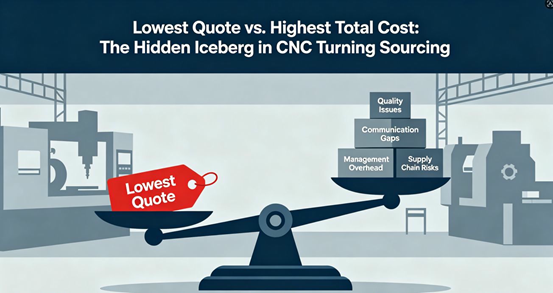
Why Might the Lowest-Priced CNC Turning Supplier Incur the Highest Total Cost?
Choosing the supplier with the lowest quote often translates to bearing significantly higher hidden costs throughout the project lifecycle. These costs typically manifest in four critical areas. First, costs from quality inconsistency. Suppliers with weak process controls can lead to soaring scrap and rework rates. A common industry scenario involves a pursuit of low price at the expense of control, potentially resulting in scrap rates of 15% or more, which erases any anticipated price advantage and wastes material. Second, costs from communication and design changes. Technical misunderstandings resulting from insufficient knowledge or language problems can prove costly and entail further modification and engineering delays. Third, coordination and management costs.
When the supplier is unable to offer its own comprehensive process, then the buyer will need to coordinate among several contractors.. Finally, supply chain risk costs. The project losses from delays caused by a fragile, unreliable supply chain far outweigh any per-part savings. Therefore, focusing solely on unit price essentially places substantial financial and project risk onto the buyer.
What Core Dimensions Beyond Price Should Be Evaluated in a Chinese Precision Turning Supplier?
Identifying a reliable long-term partner requires a procurement decision based on a multi-dimensional evaluation framework. The value of a superior precision CNC turning company is reflected in several key dimensions.
Evaluating Technical and Production Capabilities
A premier supplier’s value is first demonstrated through proactive technical collaboration. Key areas for assessment include:
- Proactive Engineering Support
Competent partners do not just quote prints; they offer Design for Manufacturability (DFM) analysis. This early-stage collaboration optimizes part design for enhanced reliability and lower total cost, preventing expensive revisions later.
- Foundations of Production Consistency
Batch stability relies on advanced hardware and systematic processes. Evaluators should examine the automation level of machining centers and sophisticated tooling management systems, which form the critical foundation for predictable, high-volume output.
Assessing Systematic Quality and Compliance
Apart from equipment, institutionalized systems also ensure long-term reliability. It is vital to ensure that a closed-loop quality assurance system exists—from material traceability to statistical process control. In addition, international certifications such as IATF 16949 are concrete proof of process traceability and operational excellence.
How Can One-Stop CNC Turning Services Substantially Compress Project Timelines and Mitigate Risk?
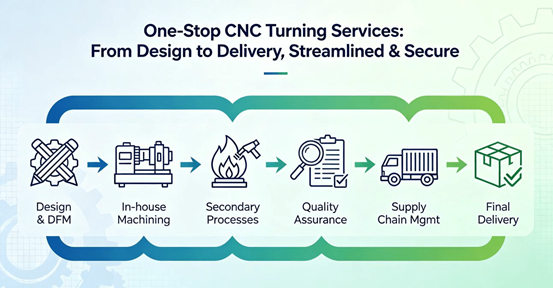
When custom CNC turned parts are required in any project, the importance of selecting an all-in-one one-stop service provider becomes critical to avoid any issues with time and risk. The benefits are felt at every stage of the process, starting from the initial quote to delivery of the components. Professional quoting involves an analysis of the process upfront so that problems could be discovered and fixed without causing any expensive changes during the design phase. Most importantly, the internal secondary processes (such as heat treatment and surface treatments), offered by reliable suppliers, prevent uncertainties, delays, and miscommunications caused by outsourcing different processes through multiple suppliers. In addition, skilled providers have sound knowledge about supply chain management and ensure that materials are readily available for smooth manufacturing. For more information, interested readers can learn about precision CNC turning services.
What Do ISO 9001 and IATF 16949 Certifications Actually Mean for Buyers of Turned Parts?
Quality certification international is an important indicator to measure the supplier’s process reliability and industry compliance.
Breaking Down Quality Management Certifications
International certifications serve as important signs of systemic adherence to quality standards. The certifications which are highly relevant include:
- Core System: ISO 9001
The certification shows that the supplier has implemented a documented quality management system geared toward meeting customer needs and improving continuously. This serves as a basic baseline for process reliability.
- Specific Industry Standard: IATF 16949 and AS9100D
In case of the automotive industry standard of ISO, additional requirements regarding defect prevention and supply-chain control apply. As regards the AS9100D for the aerospace industry, intense focus on safety and traceability applies to reduce risks in this area.
Value of Certifications to the Buyer
Certification is not only a piece of paper to the buyer. In addition, it is a predictable, audited and improved production process. This provides the buyer with an important firewall for procurement risks and minimizes project failure due to unmanaged supplier process failures..
How to Obtain a CNC Turning Quote That Reflects True Value, Not Just Price?
To secure a meaningful CNC turning quote for accurate value assessment, the buyer must initiate a professional inquiry. This involves providing a clear and complete information package: detailed technical drawings (with critical dimensions and tolerances), precise material specifications, surface finish requirements, and annual volume forecasts. A truly professional quotation is more than a final price. It should include the supplier’s optimization suggestions based on DFM analysis, a transparent cost breakdown, a realistic timeline based on capacity assessment, and a control plan for key quality checkpoints. Such a quote demonstrates technical thinking and project management capability, forming the cornerstone for a strategic partnership. Companies looking for a dependable partner for their projects are encouraged to consult with a specialized precision turning supplier to obtain a comprehensive, transparent, and value-based proposal.
Conclusion
In essence, choosing a China CNC turning supplier is a process that is fundamentally strategic in nature. The ability to achieve success will require more than a basic analysis of the first unit cost; it requires a thorough analysis of the technology available from the supplier, his or her quality system, integrated services, and the certification background associated with international business operations. With such an approach, the buyer will be able to convert hidden costs into strategic investment opportunities.
For those seeking a partner capable of combining high quality, reliable delivery, and genuine total cost advantage for their next precision manufacturing project, the expert team at LS Manufacturing offers integrated solutions from DFM analysis to final delivery. Submit your drawings today to receive a detailed, value-driven proposal.
Author Bio
Jane is an experienced manufacturing supply chain consultant who has worked in transnational precision component procurement and development for more than fifteen years. Jane’s specialty is working with international brands to improve their manufacturing and supply chain in the Asia-Pacific region.
FAQs
Q: What is the best way to confirm the real quality level of a CNC China turning parts manufacturer?
A: Aside from checking for certifications, ask for the actual documentation of their processes, such as a copy of their First Article Inspection Report and their Process Control Chart. The best way is for you to have an audit or do trial runs of a small batch of units.
Q: Are the Chinese manufacturers willing to accept small batches for prototyping?
A: Most professional Chinese manufacturers, particularly those who offer full service, appreciate helping customers with their development phase. They usually offer flexible manufacturing services that cover from prototype through production to foster business relations.
Q: What about time zone and language barriers?
A: Professional Chinese manufacturers have customer managers and engineers fluent in English. They use project management software and conduct regular video calls to ensure alignment of information.
Q: Apart from price, which other key contractual clauses should be considered in negotiations?
A: Clauses such as quality standards, liability for late delivery, IP issues, payment and inspection process, and how to handle changes are important in guaranteeing that the project runs smoothly.
Q: In case there is an issue related to quality, what would normally be the course of action?
A: A good supplier will have a quick solution where they start analyzing the cause of the problem and take appropriate action to rework or redo production. The supplier needs to provide thorough inspection documents explaining the solution to the client.