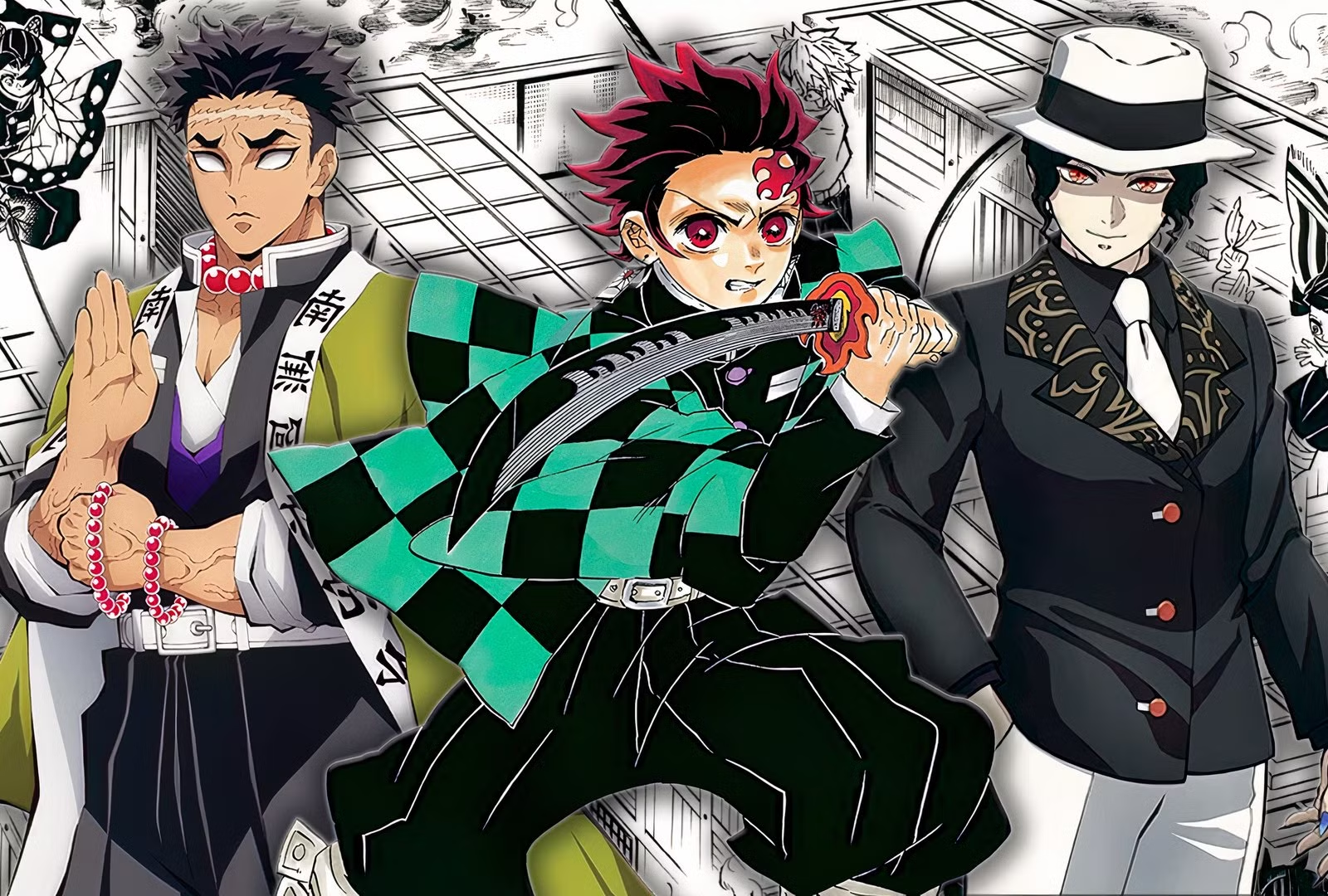
Demon Slayer’s ending brings Tanjiro Kamado’s journey to an emotional close with the defeat of Muzan Kibutsuji, the restoration of Nezuko’s humanity, and a final glimpse of a world where demons no longer threaten ordinary people. The manga concludes in chapter 205, written and illustrated by Koyoharu Gotouge, but reaching that peaceful future comes at an enormous cost. Several beloved characters sacrifice their lives during the final confrontation.
The story reaches its climax during the Sunrise Countdown Arc, when the remaining Demon Slayers unite against Muzan. Their objective is simple but almost impossible: keep the original demon occupied until sunlight destroys him. Tanjiro, the Hashira, and their allies push themselves beyond their physical limits. Victory finally arrives, yet Muzan makes one desperate attempt to preserve his existence by transforming Tanjiro into a demon.
Fortunately, Tanjiro does not remain a monster. His friends help restore his humanity, allowing him to reunite with Nezuko and begin a peaceful life. The story later moves several generations into the future, revealing the descendants and apparent reincarnations of familiar characters. This modern-day epilogue changes the meaning of the entire ending. Rather than simply celebrating the destruction of evil, it shows the lives made possible by those who fought. Some heroes survive with permanent injuries, while others find symbolic happiness through the generations that follow. Here is how the final confrontation unfolds and what becomes of the characters.
How does the final battle against Muzan end?
The conclusion of Demon Slayer remains one of the most memorable moments in modern shonen manga. Fans who collect memorabilia through anime figures canada may recognize the characters from their final confrontations, but their appearances only tell part of the story. The decisive battle is ultimately about endurance, cooperation, and the determination to protect humanity. Muzan Kibutsuji possesses overwhelming regenerative abilities, making him nearly impossible to eliminate through conventional sword techniques.
The Demon Slayers discover that their greatest advantage is time. Muzan cannot survive direct sunlight, so they attempt to prevent his escape until dawn. Tamayo’s experimental medicine also weakens him considerably, accelerating his aging and interfering with his regeneration. Every fighter contributes to this strategy, even when their injuries make continued combat seem impossible.
As sunrise approaches, Muzan transforms into a massive defensive form resembling an enormous infant. He desperately attempts to escape the sunlight, but the surviving fighters keep him exposed. The sun finally destroys his physical body, ending the terror he has spread for centuries. Muzan’s death also brings an end to the demonic threat created through his blood.
For collectors exploring Demon Slayer figures, characters such as Tanjiro, Giyu, and the fallen Hashira represent more than spectacular fighting techniques. Their designs recall the personal sacrifices behind this victory. The destruction of Muzan is particularly significant because it fulfills the Demon Slayer Corps’ centuries-long mission, even though many of its strongest warriors never live to celebrate it.
Tanjiro’s transformation and return to humanity
Defeating Muzan does not immediately guarantee Tanjiro’s survival. During the final moments of his existence, Muzan transfers his remaining blood and will into Tanjiro, hoping to create a successor capable of conquering the sun. This transformation temporarily turns the protagonist into the Demon King Tanjiro, an extremely dangerous being with extraordinary regenerative abilities.
The situation becomes especially frightening because Tanjiro can resist sunlight, something Muzan spent centuries trying to accomplish. His new instincts threaten the people who fought beside him. Giyu and the other survivors are forced to confront someone they desperately want to save rather than kill.
Nezuko plays a crucial role in reaching her brother. Having returned to human form, she refuses to abandon him, even while he attacks without understanding his actions. Kanao also intervenes by administering a medicine developed through the work of Tamayo and Shinobu. The treatment helps Tanjiro resist Muzan’s influence and recover his humanity.
Tanjiro ultimately survives, although the battle leaves permanent consequences. His right eye loses its sight, while his left arm becomes severely damaged and largely unusable. These injuries establish that even a victorious protagonist cannot escape the physical cost of the conflict. His greatest achievement is not becoming the strongest fighter. It is regaining the ordinary human life he originally wanted to share with Nezuko.
Which characters survive and who dies in Demon Slayer?
The final confrontation claims the lives of numerous major characters, particularly among the Hashira. Gyomei Himejima, the Stone Hashira, dies from the injuries sustained during the battle against Muzan. Mitsuri Kanroji and Obanai Iguro also succumb to their wounds, sharing an emotional final moment in which they express their feelings for one another.
Other losses occur during the Infinity Castle battles. Shinobu Kocho sacrifices herself as part of her plan to defeat Doma. Muichiro Tokito dies fighting Kokushibo, while Genya Shinazugawa also loses his life during that confrontation. Their deaths weaken the remaining forces but help make the eventual victory possible.
Not every major fighter dies. Giyu Tomioka and Sanemi Shinazugawa survive the final battle, although both carry serious injuries and emotional scars. Tengen Uzui, who retired from active Hashira duty earlier in the story, is also alive. The survivors must adapt to a world where their former purpose no longer exists.
Among the younger protagonists, Tanjiro, Nezuko, Zenitsu, Inosuke, and Kanao survive. Their relationships become particularly important in the closing chapters. They no longer need to train constantly, confront powerful demons, or endure dangerous missions. They finally have the opportunity to build families and experience ordinary happiness.
One particularly emotional consequence concerns the Demon Slayer Corps. With Muzan defeated and his demonic lineage eliminated, the organization officially disbands. The Ubuyashiki family has fulfilled the mission carried across generations. Kiriya Ubuyashiki, who inherited responsibility for the organization, survives to witness its success.
What happens to Tanjiro, Nezuko, Zenitsu, and Inosuke?
The surviving protagonists receive a peaceful resolution that contrasts sharply with their experiences during the battles. Tanjiro and Nezuko return to their family home, accompanied by Zenitsu and Inosuke. Their return represents the fulfillment of Tanjiro’s original goal: protecting his sister and giving her another chance at human life.
Tanjiro and Kanao eventually form a romantic relationship and have descendants, as revealed through the final chapter. Although the manga does not devote extensive scenes to their married life, their future family confirms that their feelings developed into a lasting connection.
Zenitsu and Nezuko also become a couple. Zenitsu’s affection for Nezuko has been apparent throughout the series, often expressed through exaggerated comedy. The epilogue establishes that their relationship eventually leads to a family of their own, giving Zenitsu a happy ending beyond his achievements as a swordsman.
Inosuke’s future is less explicitly explored in the main narrative. However, the final chapter and supplementary material connect him romantically with Aoi Kanzaki, who cared for wounded Demon Slayers at the Butterfly Mansion. Their descendant, Aoba Hashibira, appears in the modern timeline.
Another important survivor is Yushiro, the demon who devoted himself to Tamayo. Unlike Muzan’s creations, his existence continues beyond the final battle. He eventually becomes an artist who repeatedly paints Tamayo, preserving her memory across generations. His story offers a particularly bittersweet perspective on immortality and loss.
The modern-day ending and the descendants of the heroes
Chapter 205 moves the story into contemporary Japan, introducing characters who strongly resemble the original protagonists. This unexpected time jump reveals what the sacrifices of the Demon Slayers achieved. Their descendants live without fearing demons, while several deceased characters appear to have been reincarnated into peaceful circumstances.
Sumihiko and Kanata Kamado are descendants of Tanjiro and Kanao. Sumihiko resembles Tanjiro and displays impressive athletic abilities, while Kanata has features reminiscent of Kanao. The continuation of their family confirms that the Kamado bloodline survives the tragedy that began the story.
The Agatsuma family also appears through Yoshiteru and Toko Agatsuma, descendants of Zenitsu and Nezuko. Yoshiteru reads about the heroic battles of previous generations, demonstrating that the accomplishments of the Demon Slayer Corps have not been completely forgotten within their families.
Aoba Hashibira, a descendant of Inosuke and Aoi, becomes a botanist. He discovers the rare blue spider lily, a plant Muzan desperately searched for during his lifetime. Its appearance in the epilogue resolves one of the manga’s longstanding mysteries, although the flowers ultimately wither during Aoba’s research.
Several familiar characters receive happier outcomes through apparent reincarnation. Mitsuri and Obanai appear as a married couple running a restaurant, fulfilling the wish they expressed during their final moments. Muichiro and his twin brother are represented as young siblings, while Shinobu and Kanae appear as students.
The final chapter emphasizes that the greatest reward for these characters is a peaceful world without demons. The original fighters endured suffering so that future generations could attend school, pursue careers, form relationships, and live without constant danger. Demon Slayer ends not with another enemy appearing, but with proof that the heroes’ sacrifices permanently changed the future.