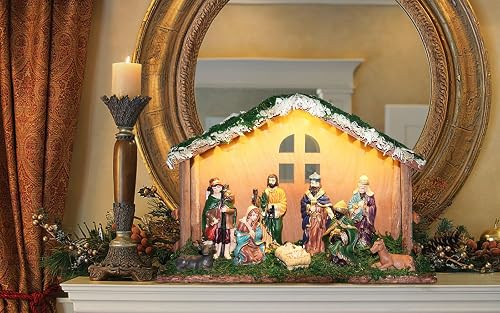
There is something rather wonderful about the fact that one of our most beloved nativity scene traditions began not with a shop display, but with a hillside in Italy nearly eight hundred years ago.
In 1223, St Francis of Assisi wanted his fellow villagers in Greccio to feel the reality of Christ’s birth rather than simply hear it read from scripture. So he gathered real animals, real hay, and a real manger, and staged what became the first living nativity. People came from surrounding villages carrying torches through the winter night, and by all accounts they wept at the sight of it. Francis had not built a decoration. He had built an experience.
That instinct, to make the Christmas story something you can see and touch rather than merely recite, is exactly why nativity scenes have endured for centuries. And it is exactly why, in an age of injection moulded plastic and same day delivery, so many families still seek out handmade displays for their homes. There is a difference between owning a nativity set and owning one that means something, and that difference is usually made by hand.
A Story You Can Read With Your Eyes
Long before most of us could read, many of us could recognise the shepherd, the ox, the kneeling figures, and the star. That is no accident. A nativity display is essentially a piece of visual storytelling, built specifically so that the Christmas story could be understood by anyone, literate or not, young or old.
In Italy this tradition took on its own name and its own life. The presepe, as it is known, became a fixture in homes, churches and even public squares, with families adding to their crib figures year after year. Grandparents would hand down a favourite shepherd or a chipped little donkey, and children would grow up knowing exactly where each piece belonged before they ever studied the Gospel accounts.
I think that is the quiet genius of the Holy Family display. It teaches without lecturing. A child places the shepherds near the stable and asks why they are the first to arrive, and suddenly you are having a conversation about humility and welcome that no amount of explaining from a picture book quite manages.
Why Handmade Still Wins Over Mass Produced
I still have a nativity figure from my childhood with a repainted arm, done rather badly by my own hand at around age nine, using paint that did not remotely match the original glaze. It looks a bit ridiculous. I would not swap it for anything.
That is the thing about handcrafted figures. They carry the marks of their making, and eventually the marks of their history too. A plastic mould gives you a perfect, identical, forgettable object. A handmade piece in resin, olive wood or terracotta gives you something with a slightly uneven edge, a distinctive expression, a texture that changes depending on the light. You can feel the hand of the person who shaped it.
That texture matters more than it sounds. Families do not tend to grow sentimental about things that were designed to be replaced. They grow sentimental about things that were designed to last, and passed down at Christmas the way a good coat or a grandmother’s recipe gets passed down. A handmade nativity set is rarely just decoration. Within a generation or two it becomes an heirloom, complete with its own small chips and its own small stories.
Regional Styles Worth Knowing
Italian Craftsmanship
Nowhere takes the presepe more seriously than Naples, where the tradition has been refined into something genuinely theatrical. Neapolitan nativity scenes are famous for their elaborate detail, with figures dressed in fabric clothing rather than painted robes, faces sculpted with real expression, and entire village scenes built up around the manger, complete with market stalls, fishmongers and washerwomen going about their day as though the birth of Christ were happening just around the corner from ordinary life.
Contemporary and Minimalist Designs
Not every household wants quite that much drama on the mantelpiece, and that is perfectly fine. Contemporary nativity designs have grown in popularity too, favouring simplified silhouettes, natural wood tones and muted, understated palettes. These pieces trade theatrical detail for quiet elegance, and many families place a modern set alongside a more traditional one without any sense of contradiction.
Ultimately, the style you choose says more about your taste in interiors than it does about the depth of your faith. Both a heavily detailed Neapolitan scene and a pared back wooden silhouette are pointing at exactly the same story.
Building a Display That Grows With Your Family
One of the loveliest ways to start a nativity tradition is also the simplest. Begin small. A basic Holy Family set, just Mary, Joseph and the infant Christ, is more than enough to start with.
From there, the display can grow the way a family does.
- Add the shepherds and a stable in year two
- Introduce the ox and donkey once you have somewhere for them to stand
- Bring in the Magi and their camels a little later
- Build out the landscape with hills, a well, or a village scene over time
Some families turn this into an annual event, unveiling one new figure each Christmas as the children get older. It becomes less about completing a Christmas crib and more about watching it evolve, which is arguably closer to what a nativity set was always meant to be, a living thing rather than a finished product.
Where and How to Display Your Nativity Scene
Placement is more flexible than people assume. A mantelpiece is the classic choice, but a hallway table, a windowsill, or a spot beneath the tree all work just as well, depending on the size of your set and the size of your home.
Indoor pieces tend to favour resin, wood or terracotta, while outdoor and garden displays call for weatherproof materials built to withstand a British winter, which, as anyone in Southampton will tell you, is no small demand.
One tradition worth keeping, regardless of where you display your set, is leaving the manger empty until Christmas Eve. The infant figure is added only once Christmas itself arrives, and the Magi are traditionally introduced later still, arriving at Epiphany rather than sitting there from the first of December. Small details like this keep the story unfolding rather than static.
A Tradition Worth Passing On
In a season that increasingly measures itself in discount codes and delivery windows, there is something almost defiant about a family gathering round a handmade nativity scene each December. It asks for nothing except a few quiet minutes of attention.
I think often of that Greccio hillside, and of villagers walking through the cold with torches simply to see something made real. We are not so different from them. We still want the story in front of us, not just told to us.
If you’re looking to start a new family tradition or expand an existing display, you can explore a wide selection of handcrafted Christmas nativity sets and accessories online, with styles ranging from classic Italian craftsmanship to contemporary designs.
However you choose to build yours, a handmade nativity scene remains one of the simplest, most enduring nativity scene traditions a family can keep.