Renovate a bathroom and the first decision is almost always colour. White tile or warm oatmeal, cool grey or something bolder – weeks go into a swatch before anyone’s thought about how the room will feel underfoot, or under a hand reaching for a towel rail in the dark.
That’s backwards. A bathroom with one confident colour and nothing else reads as flat, no matter how good the choice was. Walking into a hotel bathroom that earns the word boutique and colour usually isn’t what’s doing the work. It’s the mix of surfaces – stone against linen, matte against gloss, something rough set next to something smooth.
Texture Does What Colour Can’t
Most rooms in a house come with soft surfaces built in – a rug, a sofa, curtains, something upholstered. A bathroom starts with none of that. Tile, glass, chrome, porcelain: hard, cold, reflective, all the way round. Take texture out of the equation and there’s nothing left to absorb sound, soften light, or stop the room reading as clinical.
The bigger shift in bathroom design over the past year has been away from the ultra-minimal white box and toward materials with visible variation and depth – surfaces chosen for how they catch light and feel underfoot, not just their colour on a swatch card. Real stone, worked and honed tile, and finishes with genuine texture keep coming up as the connecting thread, not any one colour.
Fair enough, but that’s a lot of tile talk for a room most people spend twenty minutes a day in. The good news is texture doesn’t need a full retile to land.
Woven and Natural First
Rattan storage, a jute-look bath mat, a woven basket for spare towels – natural fibre texture is the easiest entry point because it doesn’t ask the room to change anything structural. It sits on top of what’s already there, and it can be swapped out just as easily if it doesn’t work.
Here’s the catch: woven materials and constant moisture don’t mix well long-term. Rattan left in direct splash zones will discolour and eventually soften. Keep it to a basket by the door or open shelving away from the shower, not the floor inside the tray, and it holds up fine for years rather than months.
The Case for Stone
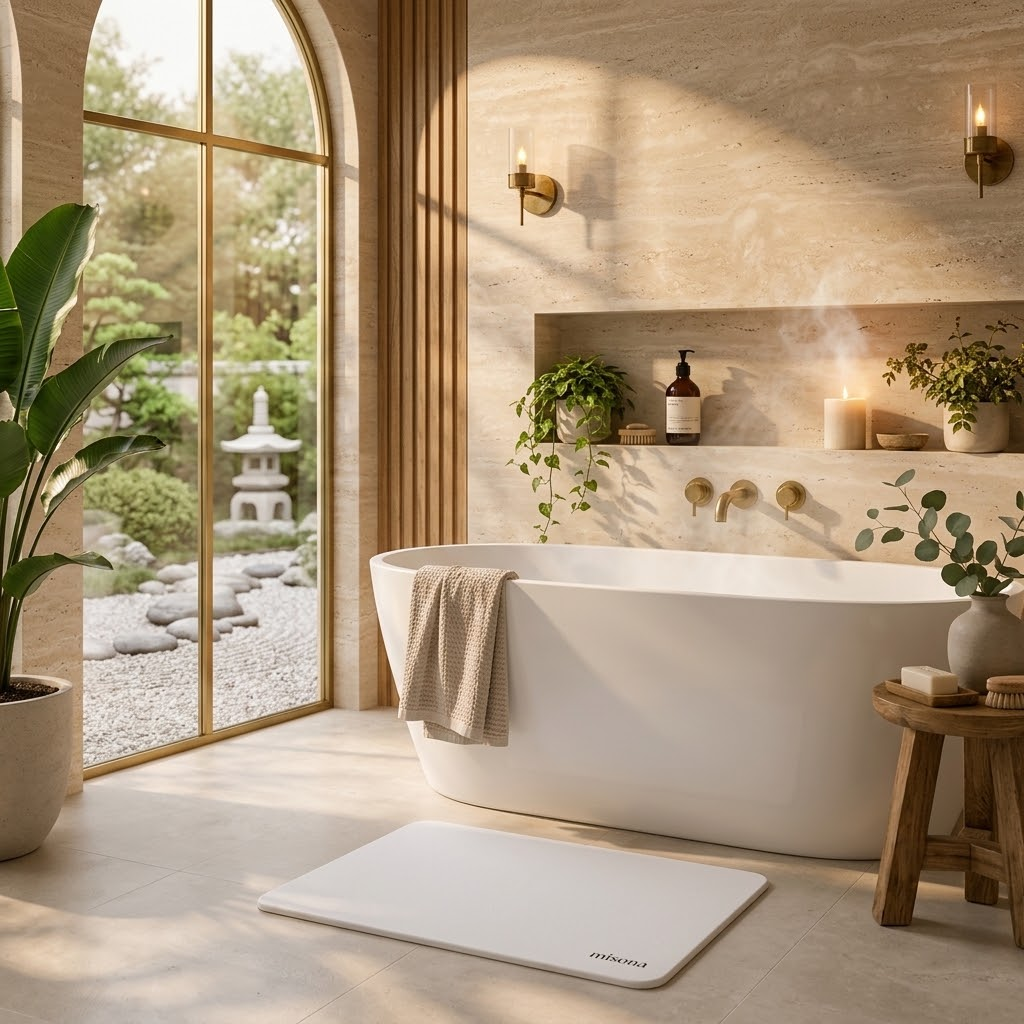
Stone is where texture stops being purely decorative and starts doing something. A tiled floor is genuinely improved by a stone surface underfoot that isn’t there just to look expensive.
Diatomite is the material behind most of what gets sold as a stone bath mat. Here’s what it is, beyond the marketing pitch: a soft sedimentary rock made from the fossilised shells of diatoms – microscopic algae that lived millions of years ago, whose silica shells compressed into porous stone over geological time. That porosity is the whole point. Diatomite typically runs 35–65% void space, and it’s this internal pore network – not the surface – that pulls water in through capillary action and lets it evaporate again within a couple of minutes.
But not every part of the floor wants stone underfoot. Stand at the vanity rather than stepping straight out of the shower and a rigid slab stops making sense – that’s where a woven-look organic cotton bath mat earns its spot instead, soft where the stone is hard, and still bringing texture rather than a flat block of colour. Two different jobs, two different materials, both doing more than the plain fabric mat they’re replacing.
Stone isn’t without downsides, though. It’s rigid, heavier than a fabric mat, and can crack if dropped hard enough on tile. Worth knowing before it becomes the only bath mat in the house.
The Layer We Forget About
Stone and cotton get all the attention because they’re new to the room. Towels rarely do, and that’s a mistake – they’re the one texture in a bathroom that’s actually soft, and set against tile, chrome and stone, that contrast does more work than it gets credit for.
A heavier-loop waffle towel or a higher-GSM towel changes how the room feels far more than a matching set in a flat, safe colour ever will. Texture first, colour second – the same rule as everywhere else in the room, and the cheapest one to act on.
Three Ways In
- Swap the bath mat first – it’s the cheapest texture change in the room and sees more daily contact than almost anything else in it.
- Add one basket, not three – a single woven or rattan piece introduces texture without competing with itself or the rest of the room.
- Go up in GSM before going up in price – a heavier towel does more for how a bathroom feels than a new colour palette, for a fraction of the outlay.
Where Layering Can Go Wrong
Two mistakes come up constantly. The first is over-layering – stone, wood, rattan, patterned tile and a textured towel all crammed into one small room reads as busy rather than considered. Pick two or three textures and let them lead.
The second is picking texture that can’t cope with the room it’s going into. A poorly ventilated bathroom sits at a genuinely different humidity level to the rest of the house for hours after every shower, and the accepted risk threshold for mould growth sits at 70% relative humidity sustained over time – exactly the range an unventilated, well-used bathroom can hold. Untreated wood, densely woven baskets and thick grout lines are usually the first things to show it. Stone and glazed tile don’t have that problem, which is part of why they’ve become the safer choice for anything close to the shower.
Fewer textures, chosen for the room they’re actually going into, beats a full set that fights the humidity from day one.
The Point of All This
None of it needs a full renovation. A bathroom can go from flat to considered with three swapped-in pieces – a stone surface underfoot, a heavier towel, one woven basket – long before anyone repaints a wall. Colour gets remembered in a listing photo. But texture is what you’re going to experience every day.
Anchor text: bathroom renovation ideas