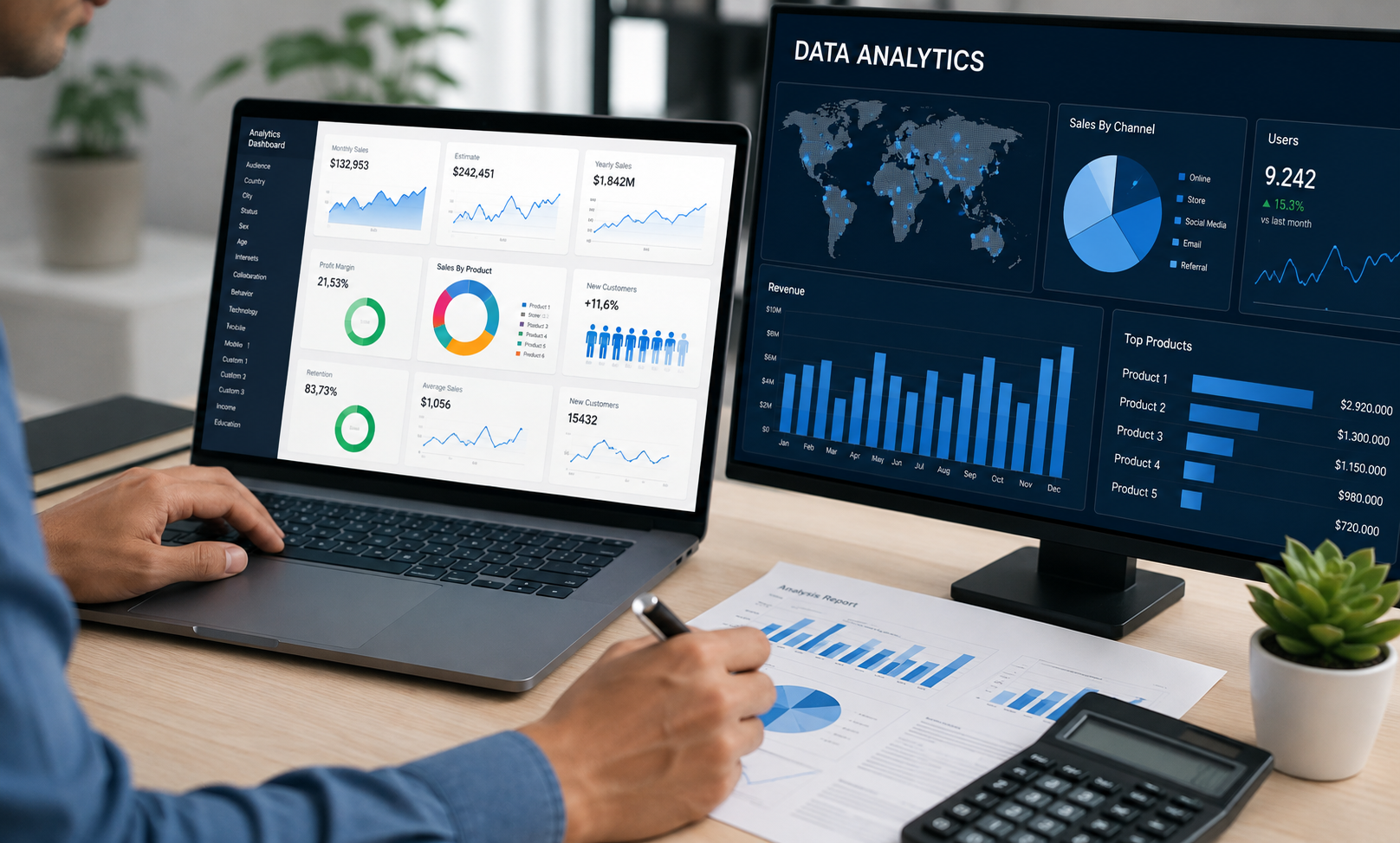
In today’s digital world, organizations generate enormous amounts of information every day. From customer purchases and website visits to social media interactions and financial transactions, data has become one of the most valuable resources for businesses. However, collecting data alone is not enough. Organizations need to understand what that data means and how it can support better decisions. This is where Data Analytics plays an important role.
Data Analytics is the process of examining, cleaning, transforming, and interpreting data to discover useful patterns, trends, relationships, and insights. Businesses use these insights to improve performance, understand customers, reduce costs, identify opportunities, and make informed strategic decisions.
What Is Data Analytics?
Data Analytics refers to the systematic process of analyzing data to extract meaningful information. It combines statistical methods, technology, mathematics, business knowledge, and analytical techniques to turn raw data into actionable insights.
For example, an online store may collect information about thousands of customers. By analyzing this information, the company can determine which products sell the most, when customers are most likely to purchase, which marketing campaigns generate sales, and why certain customers stop buying.
Instead of relying entirely on assumptions, businesses can use evidence from their data to make more accurate decisions.
Why Is Data Analytics Important?
The importance of Data Analytics has increased significantly as organizations have become more dependent on digital technologies. Companies operating websites, mobile applications, online stores, and digital services continuously generate information.
Data Analytics helps organizations transform this information into knowledge.
One major benefit is better decision-making. Managers can use analytical reports and dashboards to understand business performance and make decisions based on measurable evidence.
Another benefit is improved operational efficiency. Analytics can reveal unnecessary expenses, slow processes, production problems, and areas where resources are being wasted.
Data Analytics can also help businesses understand their customers. By examining purchasing behavior, demographics, preferences, and interactions, organizations can develop products and services that better match customer needs.
Types of Data Analytics
Data Analytics is commonly divided into four major types: descriptive, diagnostic, predictive, and prescriptive analytics.
Descriptive Analytics
Descriptive analytics focuses on understanding what happened in the past. It uses historical data to summarize business activities and performance.
For example, a company might analyze its monthly sales figures to determine how much revenue it generated during a particular period.
Common descriptive analytics tools include reports, dashboards, charts, and performance summaries.
Diagnostic Analytics
Diagnostic analytics attempts to explain why something happened. After identifying a particular result, analysts investigate the factors responsible for it.
For example, if sales declined by 15 percent in one quarter, diagnostic analytics could help determine whether the decline resulted from pricing changes, increased competition, supply problems, seasonal demand, or reduced marketing activity.
Predictive Analytics
Predictive analytics uses historical data, statistical techniques, and machine learning models to estimate what might happen in the future.
Businesses can use predictive analytics to forecast sales, identify customers who may leave, estimate demand, and detect potential risks.
Although predictions are not guaranteed, they can provide valuable information for planning and preparation.
Prescriptive Analytics
Prescriptive analytics goes one step further by recommending possible actions. It helps organizations determine what they should do based on available information and predicted outcomes.
For example, an analytics system could recommend how much inventory a retailer should order based on expected customer demand.
The Data Analytics Process
Successful Data Analytics usually involves several stages. The process may differ between organizations, but the basic workflow is often similar.
1. Define the Objective
The first step is to identify the problem or question that needs to be answered. Analysts should understand what the organization wants to accomplish before collecting or analyzing information.
A clear objective helps prevent unnecessary analysis.
2. Collect Data
Data can come from many sources, including databases, websites, applications, surveys, customer relationship management systems, financial platforms, sensors, and social media.
The quality and relevance of the collected data are extremely important.
3. Clean the Data
Raw data often contains missing values, duplicate records, formatting errors, or incorrect information. Data cleaning involves identifying and correcting these problems.
Clean data produces more reliable analytical results.
4. Analyze the Data
Once data has been prepared, analysts apply statistical methods, visualization techniques, queries, or machine learning algorithms to identify patterns and relationships.
The appropriate technique depends on the business question and type of data.
5. Visualize Results
Data visualization makes analytical findings easier to understand. Charts, graphs, dashboards, and interactive reports can help decision-makers quickly recognize trends and unusual patterns.
A well-designed visualization can communicate complex information more effectively than a large spreadsheet.
6. Take Action
The final objective of Data Analytics is to support action. Organizations need to use analytical findings to improve processes, develop strategies, solve problems, or identify new opportunities.
Common Data Analytics Tools
A wide range of software and technologies can be used for Data Analytics. The choice depends on the organization’s requirements, data volume, budget, and technical expertise.
Microsoft Excel remains a popular tool for basic data analysis, calculations, reporting, and visualization.
SQL is widely used to retrieve and manage information stored in relational databases. It is an important skill for many data analysts.
Python is commonly used for advanced analytics, automation, statistics, data manipulation, and machine learning. Libraries such as Pandas, NumPy, and Matplotlib provide useful capabilities for analysts.
R is another programming language frequently used for statistics, research, visualization, and advanced data analysis.
Business intelligence platforms such as Power BI and Tableau allow users to create interactive dashboards and reports without requiring extensive programming knowledge.
Applications of Data Analytics
Data Analytics is used across almost every industry.
In healthcare, analytics can help organizations study patient information, improve hospital operations, manage resources, and identify patterns in medical data.
In finance, organizations use analytics for fraud detection, risk assessment, customer analysis, and financial forecasting.
In retail, companies analyze purchasing behavior, inventory levels, pricing, and customer preferences.
In marketing, analytics helps businesses evaluate campaigns, measure website performance, understand audiences, and determine which channels produce the best results.
In manufacturing, analytics can improve production efficiency, identify equipment problems, manage supply chains, and reduce operational costs.
In education, institutions can analyze student performance, attendance, enrollment patterns, and other information to improve educational outcomes.
Benefits of Data Analytics for Businesses
One of the most important benefits of Data Analytics is improved decision-making. Instead of relying solely on intuition, businesses can use measurable evidence.
Analytics can also improve customer experiences. Companies can identify customer needs and personalize products, services, recommendations, and communication.
Another advantage is cost reduction. By identifying inefficient processes and unnecessary spending, organizations can use their resources more effectively.
Data Analytics can also provide a competitive advantage. Companies that understand market trends and customer behavior may be able to respond more quickly than competitors.
Additionally, analytics can help organizations identify risks before they become major problems.
Challenges of Data Analytics
Despite its benefits, Data Analytics also presents several challenges.
One major challenge is data quality. Incorrect or incomplete information can produce misleading conclusions.
Data privacy and security are also important concerns. Organizations must protect sensitive information and use data responsibly.
Another challenge is the shortage of skilled professionals. Effective analytics requires people who understand data, technology, statistics, and business objectives.
Organizations may also struggle with large and complex datasets. As data volumes continue to increase, companies need scalable systems and appropriate technologies to manage them.
Finally, analytical results must be communicated clearly. Even excellent analysis has limited value if decision-makers cannot understand or apply the findings.
The Future of Data Analytics
The future of Data Analytics is closely connected to artificial intelligence, machine learning, automation, and cloud computing.
AI-powered analytics systems can process large datasets rapidly and identify patterns that may be difficult for humans to discover manually. Automated analytics can also reduce repetitive work and allow analysts to spend more time on strategic tasks.
Real-time analytics is another important development. Instead of waiting for monthly or weekly reports, organizations can increasingly analyze information as it is generated.
Cloud technologies are also making analytics more accessible by allowing businesses to store and process large amounts of data without maintaining all infrastructure themselves.
As these technologies develop, the ability to understand and use data will become increasingly important across industries.
Conclusion
Data Analytics has become an essential part of modern business and decision-making. By collecting, cleaning, analyzing, and interpreting information, organizations can discover valuable insights and make more informed choices.
Also Read | Financial Mistakes That Slow Down High-Growth Tech Companies