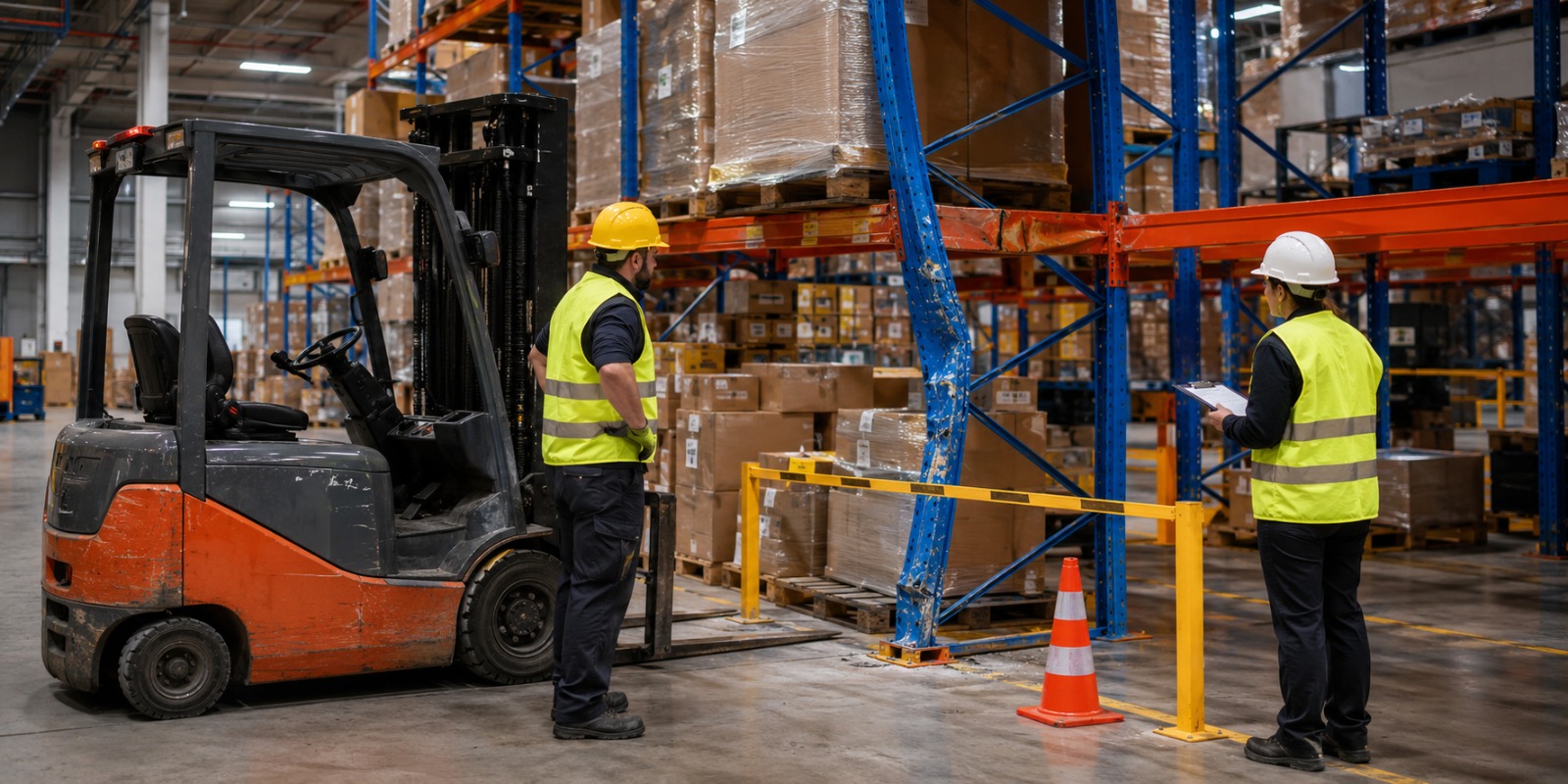
Forklifts are essential in warehouses, distribution centres and industrial storage facilities, but they also operate close to one of the most important structural elements in the building: pallet racking. Even an experienced operator can misjudge a turn, reverse too close to an upright or strike a rack while positioning a pallet.
When a collision happens, the damage should never be dismissed simply because the racking is still standing. A bent upright, damaged brace, displaced beam or loosened fixing can affect the structural performance of the system and potentially create a serious safety risk.
Knowing what to do immediately after an impact can help protect employees, stock and equipment while reducing the likelihood of further damage.
Stop Work Around the Affected Racking
The first priority after a forklift strikes pallet racking is to prevent the situation from becoming worse.
Work around the affected bay should be stopped, and employees should avoid loading additional pallets onto the damaged section. If there is any indication that the structure has been significantly compromised, access to the immediate area should be restricted until a competent assessment can take place.
Damage is not always easy to judge from appearance alone. An upright may only look slightly bent while having suffered a level of deformation that affects its load-bearing ability. Likewise, impact energy can travel through the structure and affect bracing, fixings or nearby connections.
Warehouse staff should therefore avoid assuming that a rack is safe simply because it has not collapsed.
The location of the impact should be clearly identified so that other forklift operators and warehouse workers know not to use the affected area until it has been assessed.
Arrange an Inspection and Pallet Racking Repairs
Once the immediate area has been made safe, a competent person should inspect the affected racking.
Where damage has occurred, arranging professional pallet racking repairs can help determine whether individual components need repairing or replacing and whether connected sections of the structure have also been affected.
A proper assessment should look beyond the most obvious point of impact. Depending on the collision, damage may involve the upright, horizontal beams, diagonal bracing, base plates, floor fixings, safety locks or adjacent bays.
Specialist racking engineers can identify whether damaged components remain within acceptable tolerances or whether corrective work is necessary before the rack can safely return to normal use.
Repairs should also be carried out in accordance with the requirements of the particular racking system. Pallet racking is engineered equipment, so simply straightening a bent component or replacing it with a visually similar part may not restore the original structural performance.
Understand the Severity of the Damage
Not every forklift impact causes the same level of damage.
Racking inspection practices commonly use a traffic-light approach to categorise the seriousness of defects.
Red-Risk Damage
Red-risk damage indicates a serious problem requiring immediate action.
The affected section should be unloaded and taken out of service until appropriate repairs or replacement work has been completed. Employees should not continue using the location while waiting for maintenance simply because the structure is still standing.
Examples might include heavily distorted uprights, significant frame damage or components that clearly threaten the stability of the racking.
Amber-Risk Damage
Amber damage indicates that repair work is required but that immediate unloading may not always be necessary.
However, once pallets are removed from affected locations, those positions should not normally be reloaded until the necessary corrective work has been completed.
Amber damage should not become a permanent maintenance item that remains unresolved for months. It needs to be scheduled and dealt with promptly before deterioration or another impact creates a more serious problem.
Green-Risk Damage
Green classification generally means that the deformation falls within defined limits.
That does not mean it should simply be forgotten.
The affected area should still be recorded and monitored during future inspections. If another impact occurs in the same location or the deformation becomes worse, the classification may change.
For warehouse managers, the important lesson is that damage should be assessed systematically rather than according to personal judgement.
Never Carry Out Improvised Repairs
When racking damage appears relatively minor, it can be tempting to make a quick repair internally.
For example, someone may consider hammering a bent upright back into position, welding a damaged section or fitting an available component from another racking system.
These approaches can create additional problems.
Racking components are designed to work together as part of an engineered structure. Altering their shape, drilling additional holes, welding damaged steel or introducing incompatible parts may affect how forces are distributed through the system.
A component that has been bent and straightened may also have lost some of its original structural characteristics even if it appears normal again.
For this reason, damaged racking should be assessed and repaired using approved methods and appropriate replacement components.
Check More Than the Point of Impact
A forklift collision rarely affects only the small area where contact was made.
The force can travel through the frame, so the surrounding structure should also be checked.
An inspection may include looking for:
- bent or twisted uprights;
- damaged horizontal or diagonal bracing;
- distorted beams;
- missing or displaced beam locking devices;
- damaged base plates;
- loose or pulled floor anchors;
- movement in connected bays;
- pallets that have shifted during impact;
- damaged decking or support components.
The stock stored nearby should also be examined.
A collision can shift loads or pallets even when the racking itself appears relatively stable. Products that have moved close to the edge of a pallet may create a falling-object hazard for employees working below.
Record the Forklift Incident
Every significant rack impact should be documented.
A basic incident record can include the date and time, exact location, forklift involved, operator details, photographs of the damage and any immediate actions taken.
The inspection findings and subsequent repair work should also be recorded.
Maintaining clear documentation provides several benefits. It helps warehouse managers track recurring problems, demonstrates that identified defects have been addressed and makes it easier to monitor particular areas during future inspections.
Photographs can be especially valuable because they provide a visual record of the condition immediately after the collision and after corrective work has been completed.
If the same upright or aisle is repeatedly being struck, those records can highlight a broader operational problem that needs attention.
Inspect the Forklift Before Returning It to Service
The racking is not the only equipment that can be damaged during a collision.
The forklift itself should also be checked.
Depending on the severity and angle of the impact, potential damage could involve the forks, mast, tyres, steering components, bodywork or safety equipment.
The operator should report any unusual behaviour, warning indicators or visible defects following the incident.
Where there is reason to believe the forklift may no longer be safe, it should be taken out of normal service until it has been examined by an appropriately competent person.
Returning a damaged truck immediately to a busy warehouse environment could create an additional risk.
Investigate Why the Collision Happened
Repairing damaged racking deals with the immediate problem, but warehouse managers should also ask why the impact occurred.
Forklift collisions are sometimes caused by simple operator error, but workplace design and operational pressures can also contribute.
Possible factors include narrow aisles, poor lighting, obstructed visibility, damaged flooring, inappropriate vehicle speed or pallets protruding into travel routes.
High workloads can also influence behaviour. Operators under pressure to move stock quickly may be more likely to take tight turns or position pallets less carefully.
The investigation does not need to become unnecessarily complicated. Its purpose should be to identify practical improvements that reduce the possibility of another collision.
For example, if several impacts occur at the same end-of-aisle upright, the problem may be the layout rather than the individual operators.
Improve Forklift Traffic Management
Warehouse traffic arrangements can have a major influence on racking damage.
Clear routes should be maintained wherever possible, and aisles need to provide appropriate space for the forklift equipment being used.
Good housekeeping is equally important. Shrink wrap, empty pallets, packaging materials or misplaced stock can reduce manoeuvring space and force drivers closer to the racking.
Floor markings and signage may also help establish clear vehicle routes.
In larger facilities, reviewing traffic flow can identify locations where vehicles are repeatedly forced into difficult manoeuvres. Changes to one-way systems, staging areas or pallet collection points may reduce congestion and improve safety.
Consider Racking Protection
Physical protection can sometimes reduce the consequences of forklift impacts.
Depending on the warehouse layout, suitable measures may include upright protectors, end-of-aisle barriers or other impact-protection systems.
These products are particularly useful in areas where vehicles frequently operate close to vulnerable structural components.
However, protection should be appropriate for the site and racking system. Installing guards should not reduce aisle clearance to the point where forklift manoeuvring becomes more difficult and actually increases the risk of collisions.
Impact protection should therefore form part of a wider traffic and storage strategy rather than being treated as the only solution.
Make Racking Inspections Routine
Some forklift collisions are immediately obvious. Others may occur at low speed and never be reported.
Regular racking inspections help identify damage before it becomes a larger problem.
Warehouse employees should be encouraged to report defects as soon as they notice them rather than waiting for a scheduled inspection.
Managers can also carry out regular visual checks for signs such as bent uprights, damaged braces, missing safety locks, loose fixings or unusual movement in the structure.
Periodic expert inspections provide another level of assurance by allowing someone with appropriate racking knowledge to examine the system systematically.
Inspection frequency may need to increase in busy warehouses where forklifts operate continuously around densely packed storage systems.
Train Employees to Report Damage Immediately
A strong reporting culture is one of the easiest ways to improve racking safety.
Forklift operators should know exactly what to do if they strike a rack, even when the collision seems minor.
Employees should never feel that reporting an incident automatically means they will be blamed. If operators worry about disciplinary consequences, small impacts may go unreported and damaged racking can remain in service unnoticed.
Training should explain that early reporting allows the area to be assessed quickly and may prevent a relatively minor issue from developing into a much more serious problem.
Warehouse teams should also understand the visible warning signs of damaged racking so defects can be identified during normal daily activities.
Prevention Is Better Than Repeated Repair
Forklift impacts cannot always be eliminated, but their frequency can often be reduced.
Driver training, appropriate vehicle selection, sensible aisle widths, good lighting, clear traffic routes and regular racking inspections all contribute to safer warehouse operations.
Incident records can also provide valuable information. If a facility experiences repeated impacts in one location, management can investigate whether additional protection, altered traffic routes or layout changes are needed.
Ultimately, pallet racking should be treated as important structural work equipment rather than simply as shelving.
When a forklift strikes it, the correct response is to secure the area, assess the damage, arrange appropriate repairs and investigate the cause. Acting quickly not only protects the stored goods but also helps maintain a safer working environment for everyone using the warehouse.