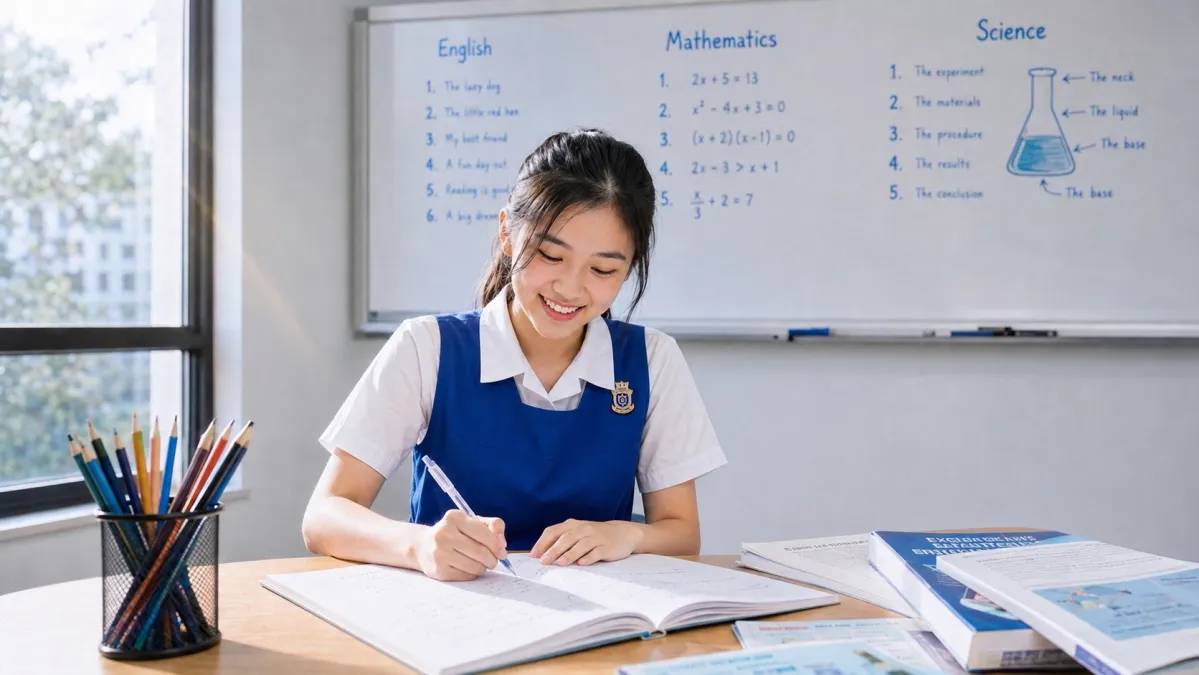
Mathematics becomes noticeably more demanding as students progress through secondary school. Topics that once involved straightforward calculations can develop into multi-step problems requiring algebraic reasoning, accurate interpretation and careful application of formulas. For students who have not fully understood earlier concepts, these increasing demands can make new chapters feel overwhelming. Building strong foundations is therefore essential, particularly when students begin encountering questions that combine several mathematical concepts and require them to explain their reasoning clearly.
Secondary math tuition can provide structured support when students need additional explanation, guided practice or opportunities to revisit difficult concepts. Rather than simply giving students more questions to complete, an effective programme can help them understand the reasoning behind mathematical methods, identify recurring mistakes and develop strategies for approaching unfamiliar problems with greater confidence. Regular practice can also strengthen accuracy, improve time management and encourage students to become more independent when solving challenging mathematical questions.
Why Secondary Mathematics Becomes More Challenging
Secondary mathematics requires students to connect different concepts rather than treat each chapter as an isolated topic. Algebra, geometry, statistics and number skills can overlap within the same question, particularly as students progress towards important school examinations.
Common challenges include:
- Translating word problems into mathematical expressions.
- Applying algebraic techniques accurately.
- Understanding why a particular formula or method should be used.
- Managing questions with several stages of reasoning.
- Interpreting graphs, diagrams and statistical information.
- Checking whether an answer is reasonable.
- Working accurately under examination time constraints.
A student may therefore understand individual procedures but struggle when a question requires several skills at once. Learning how to recognise these connections is an important part of secondary mathematics.
Building Strong Foundations Before Tackling Advanced Topics
Difficult mathematics is often connected to gaps in earlier learning. For example, a student who is uncertain about manipulating algebraic expressions may find simultaneous equations or more advanced algebra considerably harder.
Before introducing more complex material, tuition can help students revisit prerequisite concepts such as:
| Foundation Area | Why It Matters Later |
| Fractions and percentages | Supports ratios, financial mathematics and algebraic applications |
| Algebraic manipulation | Essential for equations and advanced problem-solving |
| Graphs | Helps students understand functions and data relationships |
| Ratio and proportion | Useful across geometry and applied mathematics |
| Basic geometry | Supports more complex geometric reasoning |
| Arithmetic accuracy | Reduces avoidable errors in multi-step questions |
Reinforcing these foundations can make new topics less intimidating. Instead of repeatedly memorising procedures, students begin to understand how one mathematical idea leads naturally to another.
Breaking Complex Problems into Manageable Steps
One of the most useful skills students can develop is learning how to break a difficult problem into smaller tasks.
Consider a word problem involving percentages, ratios and algebra. A student who immediately searches for a formula may become confused. A more effective approach is to:
- Identify what information is provided.
- Determine what the question is asking.
- Introduce suitable variables where necessary.
- Identify the mathematical relationship between the quantities.
- Select an appropriate method.
- Complete each stage carefully.
- Check the final answer against the original context.
This approach encourages students to think mathematically rather than react to keywords. With repeated practice, the process becomes more familiar and can improve confidence when students encounter unfamiliar examination questions.
Strengthening Algebraic Reasoning
Algebra is an area where many secondary students experience a significant increase in difficulty. Expressions, equations, inequalities and algebraic relationships require precision because a small error can affect every subsequent step.
Tuition can help students understand why each operation is performed rather than encouraging them to memorise a sequence mechanically.
For example, students should understand the relationship between expanding brackets, collecting like terms and solving equations. When these concepts are connected clearly, students are better equipped to adapt their methods when a question is presented in an unfamiliar format.
Regular practice should also include error analysis. If a student repeatedly changes a sign incorrectly or skips a necessary step, simply providing another worksheet may not solve the underlying issue. The teacher should identify the pattern and explain how to prevent it.
Developing Geometry and Visual Problem-Solving Skills
Geometry can be challenging because students must interpret diagrams while applying mathematical properties. Some learners understand formulas but struggle to determine which information in a diagram is relevant.
A strong learning approach encourages students to annotate diagrams, identify known information and establish relationships before calculating.
Students can practise by asking:
- What information is given?
- What needs to be found?
- Which angles, lengths or properties are related?
- Is there a relevant theorem or formula?
- Can the diagram be represented mathematically?
- Does the final answer make sense?
This method helps students approach geometry logically rather than relying on visual guessing.
Improving Problem-Solving Beyond Memorised Methods
Examinations can contain questions that do not look exactly like examples students have previously encountered. This is why problem-solving ability matters.
Students should become comfortable with questions that require them to:
- Compare different methods.
- Identify missing information.
- Work backwards from a known result.
- Interpret unfamiliar scenarios.
- Combine multiple concepts.
- Explain their reasoning clearly.
A useful practice technique is to give students time to attempt a problem independently before discussing the solution. This allows teachers to identify the point where the student’s reasoning breaks down.
The objective is not simply to reach the correct answer. It is to understand the decision-making process that leads to it.
Using Mistakes as Part of the Learning Process
Mathematical errors can provide valuable information. A wrong answer might result from a conceptual misunderstanding, calculation error, misreading or poor time management.
Parents can encourage students to keep an error log containing:
- The question or topic involved.
- The mistake that was made.
- The reason for the mistake.
- The correct method.
- A similar question for later practice.
This turns corrections into a learning resource. Over time, students may notice recurring patterns and become more capable of checking their own work.
How Tuition Can Complement School Learning
Tuition should support classroom learning rather than replace it. Students should continue engaging with school lessons, assignments and teacher feedback.
A programme such as Mavis Tutorial Centre can form part of a student’s broader academic support strategy when additional guided practice is appropriate. However, parents should assess whether the teaching approach suits their child’s needs instead of assuming that additional lessons alone will guarantee improvement.
The most useful tuition programmes help students connect school concepts with additional examples and gradually become more independent in applying mathematical methods.
Practical Ways Parents Can Support Mathematics at Home
Parents do not need to teach every mathematical concept themselves to support progress. They can create conditions that encourage consistent learning.
Useful habits include:
- Setting aside regular revision time.
- Asking the student to explain how they reached an answer.
- Reviewing mistakes rather than focusing only on marks.
- Encouraging careful reading of word problems.
- Avoiding excessive dependence on calculators for basic skills.
- Praising improvement in reasoning and persistence.
- Ensuring revision is spread across the term rather than concentrated before examinations.
A calm approach can be particularly helpful when students become frustrated. Mathematics often requires several attempts before a concept becomes secure.
Final Thoughts
Managing challenging mathematics topics requires more than memorising formulas. Students need strong foundations, logical reasoning, careful problem-solving habits and the confidence to work through unfamiliar questions. When these skills are developed progressively, difficult topics can become more approachable. Regular revision, thoughtful practice, consistent feedback and patience can also help students overcome learning gaps and build greater mathematical confidence over time.
Secondary math tuition can provide useful structure for students who need additional guidance, targeted practice or opportunities to revisit concepts at their own pace. The most effective support should complement school learning while encouraging students to become increasingly independent problem-solvers. For parents exploring structured academic support and mathematics learning resources, mavistutorial.com can be a useful starting point.
Frequently Asked Questions
1. When should a student consider secondary math tuition?
Tuition can be considered when a student consistently struggles with particular topics, finds classroom explanations difficult to follow or lacks confidence when attempting mathematics independently. It can also benefit students who want to strengthen their understanding before major examinations. Parents should look for persistent patterns rather than reacting to one poor test result. Identifying difficulties early can make it easier to address gaps before more advanced topics depend on them.
2. Can secondary math tuition help students who are already doing well?
Yes. Strong students can use additional tuition to develop greater problem-solving skills and practise questions that require more complex reasoning. The focus should be on application rather than simply completing more basic exercises. Advanced practice can also encourage students to explain their reasoning, compare methods and become more flexible when solving unfamiliar problems.
3. What should parents look for in a secondary mathematics tuition programme?
Parents should consider teacher expertise, curriculum alignment, class size, learning materials and the amount of individual feedback provided. It is also useful to ask how the programme identifies and addresses individual learning gaps. A strong programme should encourage understanding rather than excessive memorisation. Regular progress reviews can help parents determine whether the support is producing meaningful improvement.
4. How can students become better at solving difficult maths questions?
Students should practise identifying what a question is asking before selecting a method. Breaking complex questions into smaller stages can make the reasoning process clearer and reduce careless errors. It is also important to review incorrect answers carefully. Understanding why a method failed is often more valuable than simply looking at the correct solution.
5. How long does it take to improve in mathematics?
The timeframe varies according to the student’s starting point, learning gaps, consistency and the complexity of the topics involved. Some students may experience early improvements in confidence, while deeper conceptual progress takes longer. Consistent practice, targeted feedback and regular revision are generally more valuable than intensive short-term preparation. Students should focus on steady improvement across different mathematical skills.