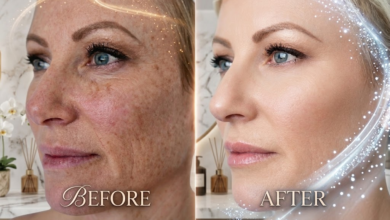
Most poor results using fillers are not due to bad technique. The product has been placed correctly in the correct volume to the correct area and yet the area in question looks worse. This is often because a plan was made for the area that the patient had complained about and not a plan based on the proportional relationships of the face that caused the area of concern in the first place.
Why the complaint site is rarely the treatment site
The person with nasolabial folds needs correction of the nasolabial folds but also has a deflated midface, a retrused maxilla or even a short lower face. Therefore, treating the nasolabial folds as if they were a totally independent problem will in 12 months have resulted in a heavier, flatter midface.
As you can imagine, face assessment is to be turned on its head when we switch to a more proportional assessment. So, first of all, we would be looking at where the face is in relation to accepted structural references, then we can identify which of the deviations are likely to cause the visible complaint(s) and, finally, we can decide whether correction in full, in part or not at all is possible by medical means or not (i.e. By surgical or by orthodontic means).
The references worth using
The lower face can be thought of as a single mechanical system. This system is defined by the projection of the chin and the definition of the jawline. The lower lip defines the lower face. The projection of the chin affects the apparent volume of the upper lip. The definition of the jawline affects the perceived width of the midface.
The following references outline the principles for a proportional assessment and can be used as such, as opposed to targets for which every patient must be made to conform. In reality, most attractive faces contain features throughout the face that deviate from the ideal ratios for each individual feature, yet they look great.
How each subunit constrains the others
When you treat areas individually, you can make a defensible face, but it won’t look total. Changing the chin can affect the upper lip, for example. Lengthening the jaw can make the midface appear wider.
- Chin. Deficient projection makes lips appear proclined and the neck appear fuller. Building the chin first often reduces the volume needed elsewhere by a meaningful margin.
- Jawline. Definition depends on the gonial angle, the mandibular border, and submental soft tissue. Filler along the border of a patient with significant submental fat will widen the lower face rather than sharpen it.
- Cheeks. The apex position governs whether the midface reads as youthful or heavy. Placing volume too medially and too low is the most common cause of the flattened, widened appearance patients describe as overfilled.
- Lips. Ratio matters more than volume. A lower lip already exceeding the classical proportion will not accommodate additional filler without distorting the vermilion border.
Sequencing decisions and what they cost
Work from the bottom up, meaning first complete the structural changes and then make the finer superficial corrections which may need to be revised.
| Stage | Focus | Typical interval before reassessment | Main risk if skipped or reordered |
| 1 | Skeletal support, chin and lateral mandible | 4 to 6 weeks | Downstream regions overfilled to compensate |
| 2 | Midface apex and lateral cheek | 4 weeks | Midface heaviness, loss of tear trough correction |
| 3 | Perioral and lip proportion | 2 to 4 weeks | Distorted vermilion, unnatural lip projection |
| 4 | Neuromodulator refinement, masseter and mentalis | 2 weeks | Muscular activity undermining structural work |
| 5 | Skin quality and fine line work | Ongoing | Textural concerns wrongly attributed to volume |
Documenting the assessment so it holds up
4. All plans are recorded consistently using the fourth point above. Free-hand impressions of a patient’s face are notoriously unreliable between appointments and between clinicians in the same practice using apparently identical methods.
A workable minimum standard
- Standardized photography at frontal, three-quarter, and true lateral, with fixed lighting and camera distance.
- Written measurement of the lower face ratio and chin position relative to the profile line.
- A short note identifying which single proportional deviation drives the patient’s stated concern.
- A record of what was deliberately not treated, and why.
Point #4 will be your defense against patients asking why their lips weren’t done at the first visit of treatment.
What comprehensive practice looks like from the patient side
More and more patients searching for facial balancing near me are aware that single-area treatment with fillers produces uneven results, so it is worth choosing a clinic that assesses the whole face before touching anything. Therefore, at the initial consultation, they have become more savvy and expect a full-face assessment including an explanation of the recommended sequencing of treatment. In addition, they expect to be told what is not possible with injectables.
Knowing when to decline
If there are severe skeletal discrepancies, significant amounts of asymmetry, or even more realistically, patients with completely unrealistic expectations for change that are outside of the realm of anatomical possibility then the best thing to do is refer them. This would be in the best interest of the patient, as even the most skilled clinicians would be unable to achieve the results that the patient is looking for, and would likely result in several revisions in an attempt to try and achieve the desired results. The number of revisions that a clinician has would be an indicator of whether or not they are conducting adequate assessments.
Also Read | Silkie Carlo: Biography, Career, Education, and Personal Life