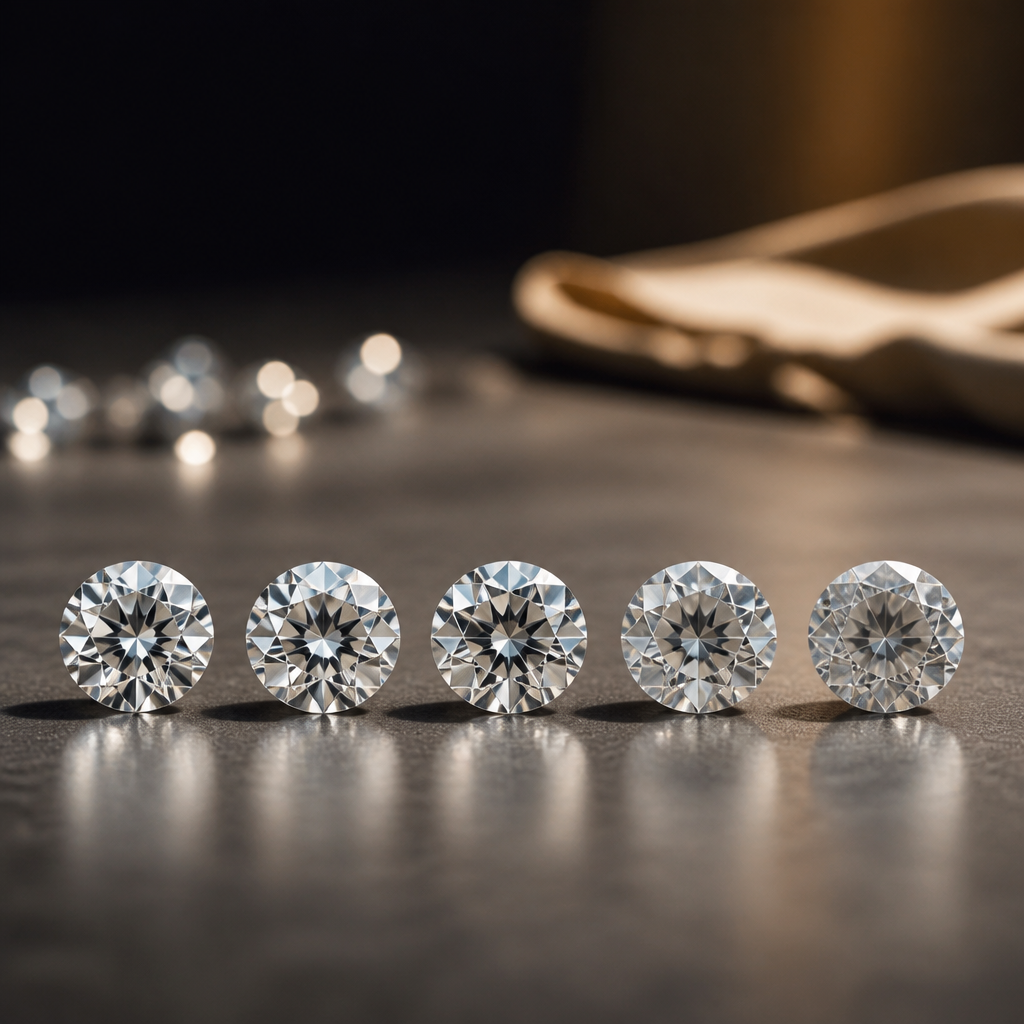
When most people think about buying a diamond, they instinctively focus on size. How many carats? How large will it look on the finger? But seasoned jewellers and gemologists will tell you that size is only one part of the story — and arguably not the most important one. The cut of a diamond, and more specifically its cut grade, is what separates a stone that dazzles from one that simply sits there. Understanding how diamonds are evaluated for their cut is essential knowledge for anyone serious about purchasing fine jewellery, whether for an engagement ring, a pendant, or a statement piece.
What Exactly Is a Diamond Cut Grade?
A diamond cut grade is not about the shape of the diamond — round, oval, pear, or cushion. Rather, it refers to how well a diamond’s facets interact with light. The grade evaluates the precision of the angles, the symmetry of the facets, and the quality of the polish applied to the stone’s surface. These factors collectively determine how much light enters the diamond, how it bounces internally, and how brilliantly it exits back through the top of the stone toward the viewer’s eye.
The Gemological Institute of America (GIA), the most widely respected authority in diamond grading, assigns cut grades on a scale ranging from Excellent to Poor. Each grade reflects a measurable difference in a diamond’s optical performance — its brightness, fire, and scintillation. A diamond graded Excellent will typically outperform a diamond graded Good, even if the latter is significantly larger or has a higher colour grade.
The Five Components of Cut Quality
GIA evaluates cut quality across five distinct components: brightness, fire, scintillation, weight ratio, and durability. Brightness refers to the total light reflected from the diamond, both internally and externally. Fire describes the dispersion of light into the colours of the spectrum — those rainbow flashes that make a diamond look almost magical under certain lighting. Scintillation is the pattern of light and dark areas and the sparkle visible when the diamond or the light source moves. Weight ratio and durability relate to how well the diamond has been cut relative to its carat weight and whether the girdle and culet are properly proportioned to protect the stone from chipping.
Why Cut Grade Matters More Than You Might Think
Consider two diamonds of identical carat weight and colour. One has been cut to Excellent standards, with precise angles and a perfectly symmetrical arrangement of facets. The other has been cut to a Very Good or Good standard, perhaps to preserve more of the rough stone’s weight. The difference in appearance between these two stones can be striking. The Excellent-cut diamond will appear more brilliant, more alive, and frankly more impressive — even to an untrained eye. The Good-cut diamond may look slightly dull or flat by comparison, despite being technically the same size.
This is why many experts recommend prioritising cut above all other factors when selecting a diamond. You can compensate for a slightly lower colour grade with the right metal setting. You can choose a shape that makes a smaller carat weight appear larger. But there is no setting or styling trick that can make a poorly cut diamond sparkle like a well-cut one.
Understanding the Grading Scale in Practice
The GIA cut grading scale for round brilliant diamonds — the most scientifically studied shape — runs from Excellent, Very Good, Good, Fair, to Poor. Excellent-cut diamonds represent the top tier, with proportions and finish that maximise light performance. Very Good diamonds are also exceptional, often indistinguishable from Excellent to the naked eye, and typically offered at a slightly lower price point. Good-cut diamonds still represent quality craftsmanship but may show minor compromises in light return. Fair and Poor grades indicate significant light leakage and are generally not recommended for fine jewellery purchases.
For fancy shapes — ovals, marquise, pear, princess, and others — GIA does not assign an overall cut grade in the same way, though it does evaluate polish and symmetry. This makes buying fancy-shaped diamonds somewhat more nuanced, requiring buyers to rely more heavily on visual inspection and expert guidance.
Leon Diamond: A Trusted Resource for Cut Grade Education
For buyers who want to go deeper into the technical details before making a purchase, understanding Diamond Cut Grades through a reputable jeweller’s educational content is an excellent starting point. Leon Diamond provides clear, accessible explanations of how cut grades are determined and what they mean in practical terms for the buyer. Their approach combines gemological accuracy with real-world purchasing guidance, making it easier to navigate what can otherwise feel like an overwhelming amount of technical information.
How Cut Grade Influences Diamond Jewellery Selection
Cut grade doesn’t just matter for solitaire rings. It plays an equally important role in pendants, earrings, and bracelets. A diamond necklace, for instance, will catch light differently depending on whether the stones are Excellent or Good cut — and that difference becomes especially apparent in varied lighting environments, from candlelit dinners to bright office settings. For those exploring the broader world of luxury diamond jewellery, Vogue’s curated guide to the best diamond necklaces offers an inspiring look at how top designers incorporate brilliance and cut quality into their most celebrated pieces.
Pairing Cut Knowledge with Product Discovery
Once you understand cut grades, the next step is applying that knowledge to actual product selection. Exploring fine jewellery catalogues with an informed eye transforms the shopping experience entirely. You begin to notice which pieces feature stones that are likely to perform well optically and which may prioritise design over diamond quality. For those looking to discover items in Rox.com’s products catalog, having a solid grasp of cut grades allows you to evaluate each piece with far greater confidence and precision.
Making the Right Choice for Your Budget
One of the most practical applications of cut grade knowledge is budget optimisation. Many buyers assume that spending more on carat weight is always the best use of their budget. In reality, a smaller diamond with an Excellent cut will often outperform a larger diamond with a Good or Fair cut — and may cost less. By prioritising cut and being willing to adjust slightly on colour or clarity, buyers can often secure a stone that looks more impressive than its price tag suggests.
The key is to resist the temptation to chase numbers on paper. A 1.5-carat diamond with a Poor cut grade will not look as beautiful as a 1.2-carat diamond with an Excellent cut. The numbers matter far less than what you actually see when the stone catches the light.
Conclusion: Cut Is the Heart of a Diamond’s Character
Of all the factors that determine a diamond’s beauty and value, cut grade is the one most directly within human control. Nature determines a diamond’s colour and clarity. The cutter determines its brilliance. When a diamond is cut with exceptional skill and precision, it becomes something genuinely extraordinary — a stone that commands attention, holds light, and rewards every glance. Whether you are buying your first diamond or adding to a carefully curated collection, understanding cut grades is not just useful knowledge. It is the foundation of making a truly informed and rewarding purchase.