Artificial intelligence is transforming how B2B businesses operate, from automating routine tasks to improving customer experiences and accelerating decision-making. However, implementing AI successfully requires more than adopting the latest tools. Without a clear strategy, businesses often struggle to achieve meaningful results.
An AI Integration Roadmap provides a structured approach to planning, deploying, and scaling AI across the organization. This guide outlines a practical Artificial Intelligence Roadmap that helps businesses align AI initiatives with their goals, reduce implementation risks, and maximize long-term value.
What is an AI Integration Roadmap?
An AI Integration Roadmap is a structured plan that guides businesses through the process of adopting and integrating artificial intelligence into their existing operations, applications, and workflows. Instead of implementing AI in isolated projects, a roadmap helps organizations define clear objectives, prioritize high-impact use cases, prepare their data and infrastructure, and measure success at every stage.
A well-planned Artificial Intelligence Roadmap also ensures that AI initiatives align with business goals, regulatory requirements, and long-term growth strategies. By following a phased approach, businesses can reduce implementation risks, improve adoption across teams, and achieve measurable outcomes rather than investing in AI without a clear direction.
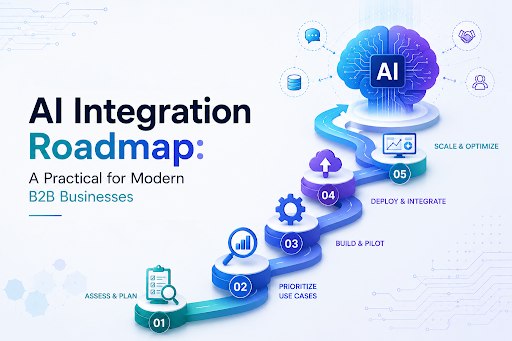
Phase 1: Strategic Alignment & Readiness (Weeks 1–4)
The first phase of an AI Integration Roadmap focuses on building a strong foundation before any AI solution is implemented. Many AI initiatives fail because businesses adopt technology without clearly defining the problem they want to solve. During this stage, organizations should align AI initiatives with business priorities, evaluate their data, and establish governance to support long-term success.
Define Business Objectives
Start by identifying the business outcomes you want AI to achieve. Instead of implementing AI for the sake of innovation, focus on measurable goals such as reducing operational costs, improving customer support, increasing employee productivity, or accelerating decision-making. Clear objectives help prioritize investments and provide a benchmark for measuring success.
Assess Data Readiness
AI systems rely on accurate, accessible, and well-organized data. Evaluate whether your business has the necessary data sources, data quality, and integration capabilities to support AI initiatives. This assessment should identify gaps, inconsistencies, or security concerns that need to be addressed before implementation begins.
Establish Compliance & Governance
As AI becomes more integrated into business operations, governance becomes essential. Define policies for data privacy, security, regulatory compliance, and responsible AI usage. Establishing clear ownership, approval processes, and performance metrics at this stage helps minimize risks and ensures AI solutions remain compliant as they scale across the organization.
Phase 2: Use-Case Prioritization & Piloting (Weeks 5–12)
With a solid foundation in place, the next step is to identify where AI can deliver the greatest business value. Rather than attempting to automate every process at once, businesses should focus on a few high-impact use cases, validate their effectiveness through a pilot, and use the insights gained to guide broader implementation.
Select High-Impact Use Cases
Prioritize processes that are repetitive, time-consuming, or heavily data-driven. Common starting points include customer support, sales assistance, document processing, knowledge management, and workflow automation. For customer-facing operations, many organizations begin with custom AI chatbot solutions to improve response times, provide 24/7 assistance, and reduce the workload on support teams.
Choose the Right AI Tools & Models
The success of an AI initiative depends on selecting technologies that align with your business objectives and existing systems. Evaluate AI platforms, language models, and integration capabilities based on factors such as scalability, security, accuracy, and ease of deployment. The focus should be on choosing solutions that solve real business problems rather than adopting the latest technology trends.
Build and Validate the Pilot
Develop a pilot project with clearly defined success metrics and a limited scope. Test the solution with a specific team, department, or business process to gather feedback and measure its impact. A successful pilot helps identify technical challenges, user adoption issues, and opportunities for improvement before expanding AI across the organization.
Phase 3: Technical Execution & Observability (Months 4–6)
After validating the pilot, the focus shifts to deploying AI in production and ensuring it performs reliably at scale. This phase involves integrating AI with existing business systems, monitoring its performance, and maintaining security throughout the implementation. Many organizations work with providers offering artificial intelligence integration services to streamline deployment and reduce implementation complexity.
Production Engineering
Deploy AI solutions into live business environments by integrating them with existing applications, databases, APIs, and workflows. Whether it’s automating internal operations or enhancing customer interactions, the implementation should be scalable, reliable, and aligned with existing business processes. For organizations requiring tailored capabilities, custom AI ML software development services can help build solutions designed for specific operational needs.
Observability & Performance Evaluation
Once AI is in production, continuously monitor its performance using key metrics such as response accuracy, latency, user adoption, and business outcomes. Regular evaluation helps identify issues early, improve model performance, and ensure AI continues to deliver measurable value as business requirements evolve.
Security & Testing
Before expanding AI across the organization, conduct comprehensive testing to validate functionality, reliability, and security. Review data protection measures, access controls, compliance requirements, and system resilience to ensure AI operates safely and consistently in real-world business environments.
Phase 4: Scaling & Continuous Refinement (Months 7+)
Once AI has demonstrated measurable value, the next step is to expand its adoption across the organization. Scaling AI isn’t just about deploying it to more teams—it’s about continuously improving performance, increasing user adoption, and identifying new opportunities where AI can create business value. This phase ensures your AI Integration Roadmap evolves alongside changing business needs.
Upskilling & Training
Successful AI adoption depends on people as much as technology. Provide employees with the training and resources they need to use AI tools effectively. Encourage collaboration between business teams and technical teams to build confidence, improve adoption, and maximize the value of AI-driven workflows.
Performance Optimization
Continuously monitor AI performance using operational and business metrics. Analyze user feedback, identify bottlenecks, and refine models or workflows to improve accuracy, efficiency, and reliability. Regular optimization ensures AI continues to meet business objectives as requirements evolve.
Expand AI Across the Business
After achieving success in initial deployments, extend AI to additional departments and business functions. Organizations often begin with customer service or internal operations before expanding AI into sales, marketing, finance, HR, supply chain, and decision support. Scaling strategically allows businesses to maximize return on investment while maintaining consistent governance and operational control.
Conclusion
AI integration is not a one-time initiative but an ongoing business transformation. By following a structured AI Integration Roadmap, B2B organizations can reduce implementation risks, prioritize the right opportunities, and scale AI with confidence. Taking a phased approach ensures every investment delivers measurable business value while supporting long-term growth.
Whether you’re planning your first AI initiative or expanding existing capabilities, partnering with an experienced technology provider can simplify the journey. At Techvoot, we help businesses design, build, and integrate AI solutions that align with their operational goals, enabling organizations to move from experimentation to enterprise-wide AI adoption with confidence.