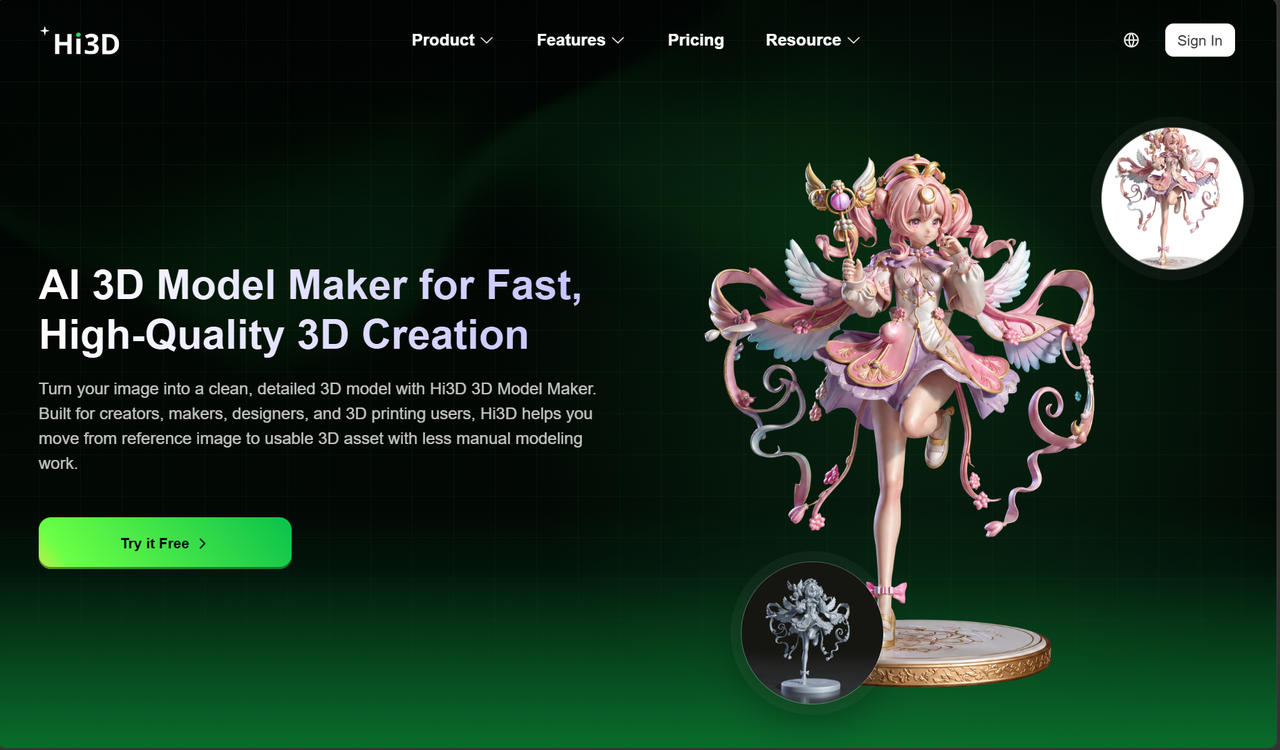
1. 3D Printing Is Becoming More Accessible, but Creating the Right Model Remains a Challenge
3D printing is gradually moving beyond professional studios and industrial applications. Today, creators, designers, hobbyists, educators, and everyday users are using 3D printers to turn ideas into physical objects, from personalized collectibles and creative decorations to prototypes and functional designs.
However, as 3D printing becomes more popular, a new challenge has appeared. The difficulty is no longer only about printing an object — it is about creating a suitable 3D model before printing. A digital idea still needs to go through multiple steps: concept creation, model generation, texture design, print preparation, and final optimization.
This is where AI-powered 3D creation tools are changing the workflow. Instead of spending hours learning complex modeling software, users can now start from images, text descriptions, or simple ideas and quickly transform them into printable 3D content.
Among these emerging solutions, Hi3D focuses on solving the complete journey from imagination to physical creation. As an AI-powered 3D model maker, Hi3D is designed not only to generate 3D models, but also to help users prepare those models for real-world printing.
2. Why Traditional 3D Model Creation Still Creates Problems for Many Users
For many new 3D printing users, the biggest barrier is not owning a printer — it is creating a printable model. Traditional 3D modeling software often requires professional knowledge, including mesh editing, topology control, texture creation, and preparation for slicing.
2.1 Beginners often have ideas but lack professional modeling skills
A beginner may have a clear idea of a character, product concept, or personalized object, but turning that idea into a complete 3D model can still feel complicated.
Hi3D simplifies this process by allowing users to create models through more natural inputs. Instead of starting from a blank modeling workspace, users can begin with images or descriptions and let AI assist with the creation process.
2.2 Existing AI-generated models often stop before the printing stage
Many AI tools can generate visually impressive 3D models, but the workflow often ends after the model is created. Users still need to repair meshes, adjust structures, prepare parts, and optimize printing settings before they can actually produce the object.
For 3D printing enthusiasts, the most valuable workflow is not only “AI creates a model”, but “AI creates a model that can move closer to printing.”This is the direction Hi3D focuses on — connecting AI generation with practical 3D printing preparation.
3. Hi3D Makes 3D Model Creation Faster with AI-Powered Generation Tools
One of the most common challenges for creators is transforming a visual idea into a three-dimensional object. A picture may capture the appearance of a character, product, or design concept, but converting that image into a usable 3D model traditionally requires manual modeling.
3.1 Create printable models from images with AI-powered conversion
With Hi3D’s image to 3D model workflow, users can turn 2D visual references into 3D creations more efficiently. Whether it is a personal design, character concept, or creative artwork, the AI-assisted process helps bridge the gap between a flat image and a printable model.
This makes the technology especially useful for creators who have strong visual ideas but limited 3D modeling experience. Instead of spending hours rebuilding a design manually, users can start from existing images and quickly explore three-dimensional possibilities.
3.2 Text-to-3D creation helps transform imagination into models
Not every idea begins with an image. Sometimes creators only have a description in their mind: a fantasy character, a customized object, or a unique collectible design.
Hi3D allows users to generate 3D models from text-based concepts, making creative exploration more flexible. Users can describe what they want to create and use AI assistance to develop a starting model.This approach lowers the barrier for people who want to experiment with 3D printing but do not have experience with traditional modeling tools.
3.3 A more practical free 3D model maker experience
Many AI creation platforms focus mainly on generating attractive digital assets. Hi3D places more attention on the connection between creation and printing.
As a free 3D model maker experience, Hi3D helps users explore AI-generated models while also considering how these models can become physical objects. The goal is not simply producing a digital file, but creating a smoother path toward actual printing.
4. AI Texturing Brings More Detail and Creativity to 3D Models
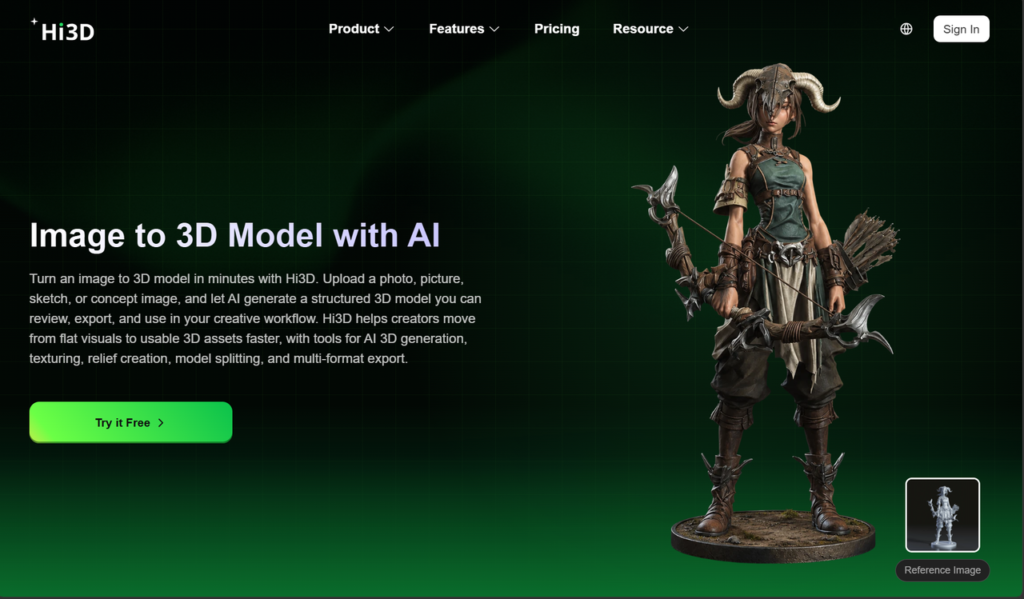
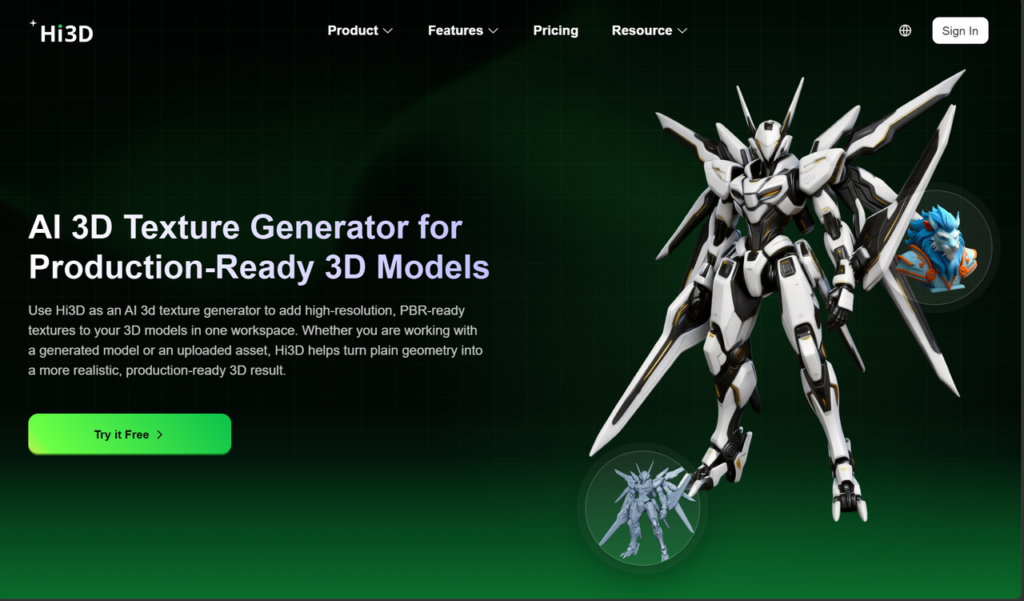
A 3D model is not only about shape. Surface details, colors, and visual style play an important role in the final appearance of printed objects.With Hi3D’s AI 3D texture generator capability, users can enhance models with AI-assisted texture creation, adding more visual information and personality to their designs.
4.1 Moving beyond basic geometry with AI-generated textures
For character creators, collectible makers, and creative designers, texture generation provides another layer of customization. Instead of manually painting every detail, users can use AI assistance to develop richer surface appearances.
4.2 AI texturing supports a more complete creation workflow
Traditional workflows often separate modeling and texturing into different stages, requiring users to switch between multiple tools.
Hi3D integrates AI texturing into the broader creation process, helping users move from concept generation to a more complete 3D design workflow.
Combined with AI model generation, this creates a smoother process where users can explore shapes, styles, and appearances before preparing the final object for printing.
5. From Digital Models to Real Prints: Hi3D Solves the Final Printing Challenges
A common problem with AI-generated models is that visual colors do not always translate easily into physical printing.Large or complex models often create another problem: they may not fit into a printer’s build volume or may require difficult manual preparation.
5.1 Multi-color printing makes AI creations more realistic
Hi3D’s multi-color printing workflow focuses on transforming textured 3D models into printable multi-color objects. It helps generate printable color regions, match colors with available filament options, and reduce unnecessary manual color adjustments.
Instead of treating colors as simple digital information, Hi3D considers how colors can work in actual filament-based printing. This helps creators produce models that better match their original design intention.
5.2 Split models into printable parts without complicated manual editing
Hi3D’s split-for-printing feature helps divide complete models into printable components. For character models, it can separate areas such as the head, torso, arms, legs, weapons, and base, while also generating connectors for assembly.
This makes it easier for creators to handle larger models and prepare them for real printing without relying heavily on complicated manual cutting workflows.
5.3 Smart arrangement reduces preparation time before printing
Even after generating and editing a model, preparing it for printing can still take time. Users often need to adjust orientation, arrange parts, and configure printing settings manually.
Hi3D’s smart arrangement workflow helps users organize models on the build plate, suggest better print orientations, and export 3MF files with suggested slicer settings.
This focuses on one of the most overlooked parts of 3D printing: reducing the gap between having a model and successfully preparing it for production.
6. What Makes Hi3D Different from Other AI 3D Generation Platforms
Many AI 3D tools focus mainly on generating models. Platforms such as Meshy and Tripo have helped popularize AI-assisted 3D creation, but users often still need additional steps before printing.
6.1 More than a 3D generator — a complete printing-focused workflow
Hi3D’s key difference is its focus on the complete workflow. It is designed around the practical needs of 3D printing users — from generating models, improving appearance, preparing colors, splitting complex designs, arranging parts, and moving toward printable files.
The value of an AI 3D model maker AI solution is not only how quickly it creates a model, but how effectively that model can become a physical object.
6.2 Designed for creators who want to print, not only create
For many users, the final goal is not a digital model displayed on a screen. The goal is holding the finished object in their hands.
Hi3D connects AI creation with printing preparation, creating a workflow closer to:Idea → AI generation → Model improvement → Print preparation → Physical object
This approach makes Hi3D especially suitable for makers, designers, collectors, and anyone who wants to transform creative ideas into real-world results.
7. Hi3D Anniversary Celebration: Start Creating Your Next 3D Project
AI and 3D printing are opening a new chapter for digital creativity. The ability to transform ideas into physical objects is becoming easier, faster, and more accessible than ever.
Hi3D continues to focus on making the entire creation process smoother — from generating models to preparing them for printing.
To celebrate its first anniversary, Hi3D has launched a limited-time promotion with special offers, including discounts on its services.
Whether you are exploring AI 3D creation for the first time or looking for a more efficient workflow as an experienced maker, Hi3D provides a more complete way to move from imagination to reality.Start creating, explore new possibilities, and bring your next idea into the physical world with Hi3D.




