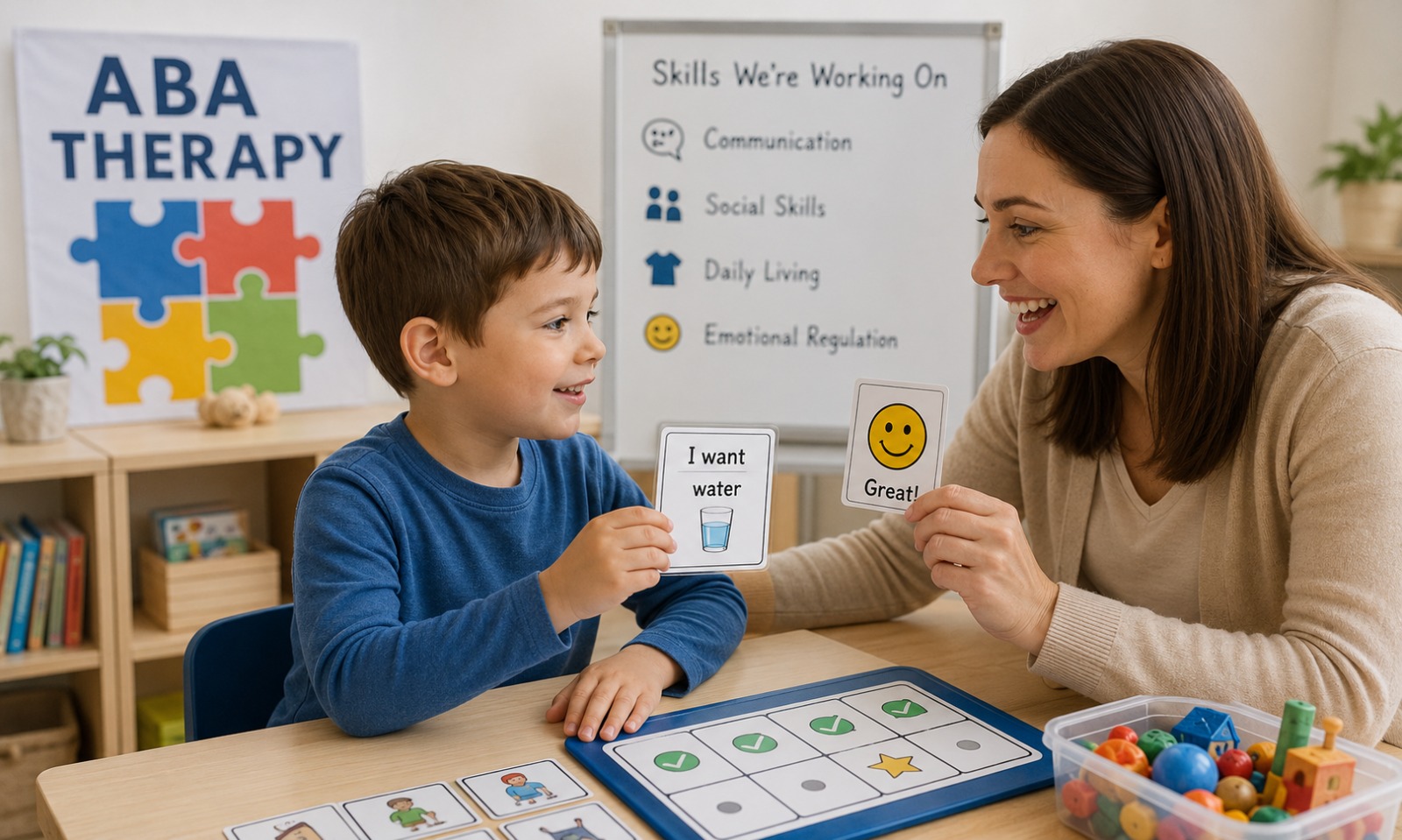
As for ABA, a few years ago, I spent about 40 minutes watching a child learn how to ask for a cup of water to drink. I say “ask for” instead of “request” because during this 40 minutes the child learned to ask for a cup of water instead of simply demanding a cup of water. He did amazingly well when he finally did ask for a cup of water – calm, clear, and expecting to get it. It was a very cool thing to see. Even to this day, I am at a loss for how to describe the look on his face. It was good.
I recently was to to eat with a child in a restaurant and it took him forty minutes to ask for a cup of water in the restaurant. He did ask for it and there was a child’s quiet triumph in getting what he wanted after so long working at getting what he wanted. He was a memorable child as this was a very memorable moment for me in terms of insight into the required skills to be able to interact in a restaurant with people and the length of time that children take to learn even these very small, simple skills.
This brings us to Applied Behavior Analysis, or ABA therapy.
So what actually happens in ABA therapy?
A lot of people mistakenly believe that ABA is a collection of different tricks and techniques used to change behavior. However, to those who are familiar with ABA, it is a scientific approach or methodology. The methodology is used to understand how people learn behaviors, how behaviors are reinforced, and how behaviors can be changed. In order to apply the ABA methodology, one must pay close attention to a person’s behavior in order to better understand him or her and to teach new skills in order to increase the quality of life of that person.
Every learning trial in ABA therapy is completed within a few minutes, and each trial is set up to teach one new skill within a session. Consistently clear and direct prompts are used to teach new skills. Following each attempt by a child to complete a new skill, the therapist immediately assesses whether the child was correct or not. When a child correctly completes a new skill, the child is given positive reinforcement such as playing with their favorite toy, looking at pictures, or putting a sticker on a sheet of paper. This process is continued for several minutes within each session of ABA therapy, in order to allow a child to learn new skills within a session of therapy, and to allow a child to practice using new skills that they have learned in previous sessions of ABA therapy.
The next step for the child is to start to apply these new skills in natural situations. The child and therapist will start to apply the skills that the child has learned in therapy in the child’s natural environment. This is done by slowly and often imperceptibly removing the supports that the child and therapist used in therapy. This process is called fading.
The skills ABA therapy actually targets
ABA Therapy can have the wrong perception given to people. Many people believe the primary goal of ABA Therapy is to decrease problem behaviors, such as tantrums, etc. While reducing negative behaviors are often a byproduct of an ABA Program, the primary focus of an ABA Program should be teaching new skills to increase positive behaviors. Therefore, for the last 40+ years, the predominant perspective in the ABA community is to teach new skills (behaviors) to increase functional behaviors in people with autism spectrum disorder.
- Communication skills, including both verbal language and alternatives like picture exchange systems or AAC devices for children who don’t yet use speech reliably
- Social skills like taking turns, reading facial expressions, and understanding that other people have different perspectives (which, when you think about it, is something plenty of adults still struggle with)
- Daily living skills such as dressing, brushing teeth, managing transitions between activities
- Emotional regulation and coping strategies when situations feel overwhelming
The skills that ABA Therapy teaches can vary depending on the age and needs of the child. A four year old nonverbal child’s goals are going to be vastly different from a 10 year old child with autism who is trying to hold on to his spot in regular education and struggling to manage his frustration in the various situations he encounters on a daily basis.
How progress actually gets measured
Each session of ABA would be tracked by counting the correct responses that the child made and the number of prompts that the therapist used to elicit those correct responses. By looking at the data from each session of ABA the therapist can monitor whether the child’s behavior is increasing or decreasing over time. If the child’s behavior were to cease increasing and instead start to decrease then that would indicate that it would be time to change up the child’s program and to re-evaluate the child’s needs in order to continue to make progress.
After each session the data that the therapist collected during the session can be entered into the app or on a spreadsheet. From there the information can be looked at by the therapist, and the team of people who are working with the child, to see if the child learned the skill that the were working on during the session. This information can also be looked at over time to see if the child is getting better at using the skills that they have learned. If the information from the data collected shows that the child is not getting better at using the skills as quickly as the team would like then the information from the data can be used to make changes to the skills that the child is learning and the ways in which the child is practicing the skills. This ensures that the program is working well for the child and does not have to continue doing something that is not working well for the child. Small changes can be made based on the information from the data.
| Skill area | Example target | How progress is tracked |
| Communication | Requesting preferred items using words or AAC | Number of independent requests per session |
| Social interaction | Maintaining eye contact during greetings | Percentage of trials with correct response |
| Self-care | Completing a morning routine with minimal prompts | Number of steps completed independently |
| Emotional regulation | Using a calming strategy when frustrated | Frequency of strategy use vs. escalation |
All of the skills listed in the above table are of capability which means that for ABA therapy to be most beneficial to a child, those skills must be something that the child can do.
Finding the right fit for your child
While there are many ABA programs that could be good for your family, what works for one family may not work for another. Families need to dig deeper to find a program that is just right for their child. A good ABA program will work with a child and their family to set up a positive learning environment that is safe and in which the child feels in control. Families also need their child’s learning to be enhanced by their involvement in their child’s learning by having their family involved in training sessions with their child’s therapist and by having goals that are set for their child with their family. These goals should be based on the family’s priorities and values and must be chosen by a team who can explain why they were chosen for a child to learn.
You need to research different ABA programs and decide which program will be best for your child and family. A good ABA program will include the child’s assent into the different skills that the child is learning in ABA. A good ABA program will include the family in the different skills that the child is learning in ABA and in the training of the child in the different skills that the child is learning in ABA. A good ABA program will include goals that are of importance to the family that are being worked on by the child in ABA in order for the child to learn the different skills that the child is learning in ABA. The program should also be able to explain to you why the goals that they have chosen for your child were chosen for your child.
A huge thanks to centers for Applied Behavior Analysis (ABA) for autism treatment in North Carolina through the organization. In particular, I am thankful for Bierman Autism Centers (www.biermanautism.com) and their many locations for ABA therapy in North Carolina, as well as all of the other ABA centers throughout the southeastern US. These ABA centers offer the most effective treatment for children with Autism Spectrum Disorders by providing individually designed programs that promote the most productive and meaningful behaviors. Each ABA center for autism treatment in NC offers the most experienced, and compassionate staff that form relationships with not only the children receiving ABA therapy for autism in NC, but also with the families of the children. Families interested in effective, research-supported and individualized ABA therapy for autism in NC should explore the many centers located throughout the state. Families should also ask each center about the specific supports that each center offers. Explore more practical lifestyle advice for modern living.
A final thought
Each child will grow and learn at his or her own pace. There will be times of great growth in a short amount of time, and there will be times when it may seem as though no new skills have been learned. However, even when it seems as though a child is not making any progress, there are still many skills that are being learned. ABA is a program designed to help children to learn to reach their full potential in all environments. The goal of ABA is not to force children to learn in ways that are not natural for them. Rather, the goal of ABA is to create situations in which children can learn and grow in the ways that are best for them. The end result is that children will grow in a variety of ways, achieving their own full potential. Each child will have his or her own successes, big and small, and these should be celebrated along the way.
This child would have learned one skill and then he could use that skill in many different situations. He could use that skill in his classroom, he could use that skill in the cafeteria at lunch, he could be at his friend’s birthday party and there will be kids at that party that he doesn’t know. He would be able to ask for water if he needed it.
Also Read | Why Are Regular Visits to a Dental Hygienist Important?