Modern engineering often needs materials that can do more than the usual options. Engineers want high strength with low weight, the ability to handle high temperatures, and freedom to build complex shapes. That’s why many teams use advanced structural foams made from polymethacrylimide (PMI).
In particular, Chem-Craft Rohacell Foam is a leading core material used in high-performance composites across many industries. So what makes this foam so useful, and why do industries that cannot risk failure rely on it?
Chem-Craft Rohacell Foam is based on PMI chemistry. It is a rigid, closed-cell structural foam that sits at the center of lightweight sandwich structures. Using it in high-performance composites is not just about cutting weight. It also helps improve strength, heat resistance, and manufacturing speed. For more than 50 years, this material has helped aerospace, automotive, medical technology, and other markets make parts that are lighter and stronger.
What Is Chem-Craft Rohacell Foam and Why Is It Used in High-Performance Composites?
Chem-Craft Rohacell Foam is a rigid, closed-cell foam made from polymethacrylimide (PMI). Compared with many other rigid foams, it offers a rare mix of properties that fit demanding composite uses. It is not just “space filler.” It acts as a structural part of the design and adds to the final strength and performance of the composite.
It is widely used because it provides strong mechanical performance at very low densities, along with excellent heat resistance and strong creep compression behavior. This lets engineers build very light parts that can still take high loads and handle high-temperature processing, which are key needs in advanced composite manufacturing.
Key Properties of Chem-Craft Rohacell Foam
The main strengths of Chem-Craft Rohacell Foam come from its mechanical and thermal performance. It has high specific strength, meaning it gives high strength for its low weight. This makes lightweight construction easier because engineers can often choose lower-density grades without losing too much strength, which reduces total weight.
Rohacell is also 100% closed-cell and has isotropic performance, so its properties stay consistent across the sheet or molded part. The closed-cell structure is important because it reduces resin absorption during composite production. That helps avoid extra weight and makes processing easier. Its high heat distortion temperature and strong creep compression resistance (compared with many other rigid foams) help it keep its shape during high-temperature curing, which is a major benefit in many composite processes.
Formulations and Available Grades
Chem-Craft Rohacell Foam is available in many grades, each made for certain needs like density, cell size, and strength. For example, the general-purpose ROHACELL® IG-F series is available in nominal densities from 31 to 110 kg/m³ with a maximum curing temperature of 130°C. This makes it a flexible option for industrial, medical, sport, automotive, and electronics uses.
For harsher conditions, grades like ROHACELL® XT and XT-HT provide the highest temperature and compression resistance, with curing temperatures up to 190°C. These are a good fit for aerospace and high-temperature industrial processing. Other special grades include ROHACELL® S, which has improved fire behavior and passes the 60s vertical burn test standard to FAR 25.853 for aircraft, railway, and shipbuilding uses. ROHACELL® HF is used for high transparency and strong dielectric performance for sensitive electronics and antenna parts.
The HERO series, such as ROHACELL® HERO (51, 71, 110, 200 kg/m³), is made for aerospace structural parts. It offers higher temperature and compression resistance up to 180°C and is always supplied as a heat-treated version for better performance. The RIMA series (51, 71, 110 kg/m³) has a fine cell structure to reduce resin absorption while still offering strong temperature and compression resistance, making it suitable for aerospace, automotive, sport, and industrial use. This wide set of options helps engineers pick the grade that matches their exact needs.
Core Material Role in Composite Structures
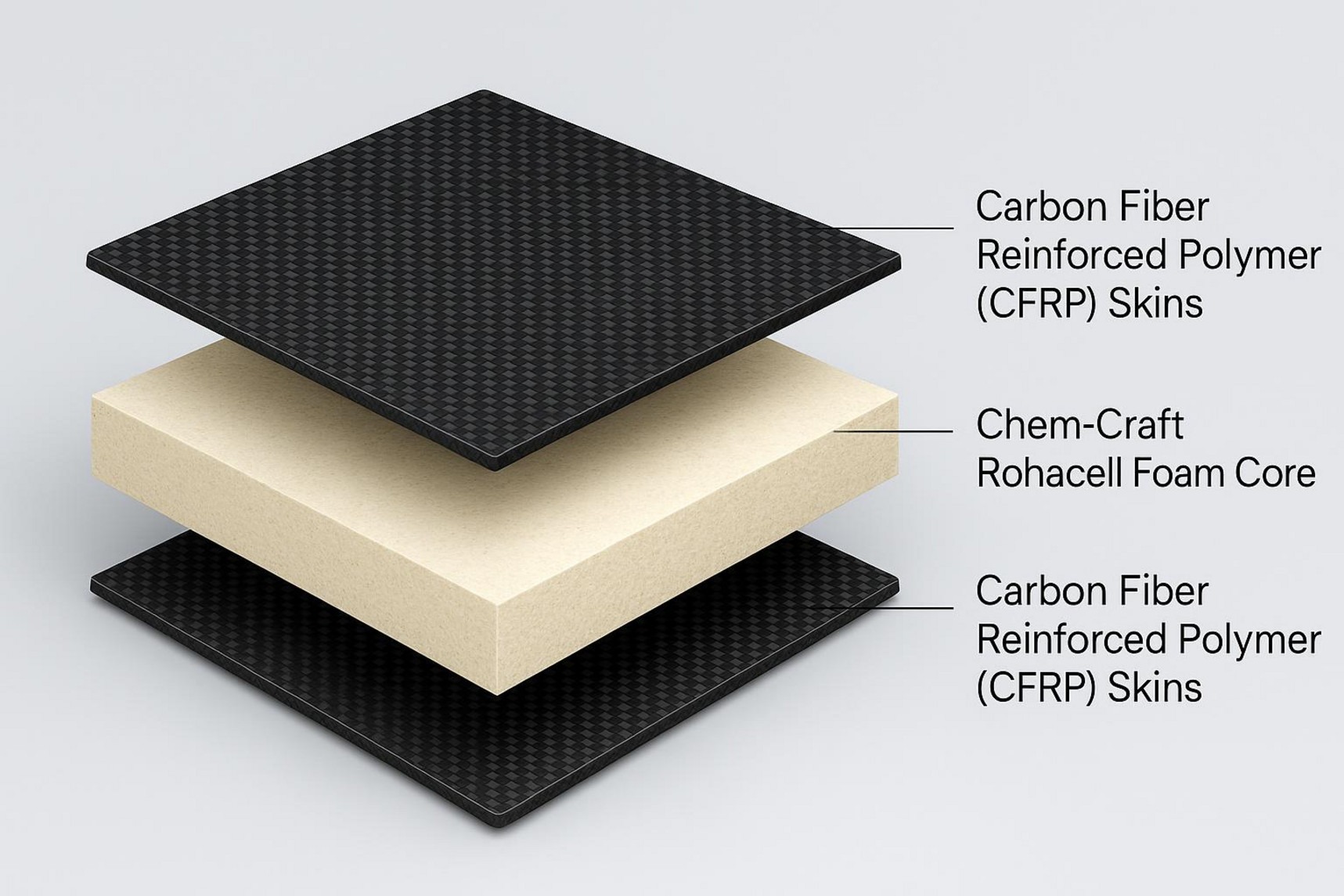
In composite manufacturing, Chem-Craft Rohacell Foam is mainly used as a core in sandwich structures. The foam sits between thin, high-strength skins, such as carbon fiber reinforced polymers (CFRP) or metal foils. This setup creates very stiff, strong parts at much lower weight than solid materials.
Rohacell is also used in other ways, such as a production tool in fiber placement and filament winding, and as a flyaway mandrel. Because it can be thermoformed into complex shapes and machined accurately, it can act as a draping aid for profile-reinforced shells (like hat stringers) and as a load-bearing structural core. It also fits well with newer automated methods for building sandwich composite parts, helping improve production speed and repeatability.
How Chem-Craft Rohacell Foam Improves Composite Performance
Adding Chem-Craft Rohacell Foam to composite designs leads to a set of performance improvements that many industries rely on. These improvements help solve common engineering problems, like cutting operating costs through weight savings, improving safety, and helping parts last longer.
By turning standard structures into lightweight, strong parts, Rohacell supports designs that can be hard to reach with older materials. In many high-performance uses, its built-in properties are helpful and often required.
Thermal Resistance and Creep Compression Strength
One of the biggest benefits of Chem-Craft Rohacell Foam is its heat resistance and creep compression strength. Unlike many other rigid foams, it keeps its mechanical properties at high temperatures and under long-term loads. This matters during composite curing, where temperatures can reach up to 190°C depending on the resin and the Rohacell grade.
This heat stability helps the core avoid damage, shape change, or loss of strength during autoclave curing and other warm curing steps. High creep compression strength also helps stop the foam from slowly compressing under pressure over time. This supports long-term dimensional stability and steady performance, even in harsh operating conditions.
High Specific Strength-to-Weight Ratio Benefits
Many industries constantly work on lightweight construction because it improves fuel use, increases payload, and improves performance. Chem-Craft Rohacell Foam performs well here because of its strong strength-to-weight ratio. For the same strength level, a part made with Rohacell can be much lighter than one made with other options.
This weight reduction brings clear gains: in aerospace it can cut fuel use and extend range; in automotive it can improve acceleration, handling, and fuel economy; and in sports equipment it helps create lighter, more responsive products. Structural foam cores can also turn hollow areas into load-bearing structures that increase torsional stiffness and help manage crash energy without adding much weight.
Influence on Resin Uptake and Core-Facing Adhesion
The closed-cell structure of Chem-Craft Rohacell Foam helps control resin uptake during manufacturing. Resin mainly enters only the exposed cut cells on the surface, so it does not soak deep into the core. This controlled uptake helps avoid extra weight in the finished part and keeps the lightweight benefit.
It can also reduce resin use, which lowers material cost. At the same time, surface cells can help the adhesive system “grab” mechanically, improving the bond between the foam and the composite skins. This core-to-skin bond is key for the strength and service life of sandwich panels.
Design Freedom and Machinability Advantages
Chem-Craft Rohacell Foam gives engineers a lot of freedom in shape. Because it can be thermoformed into complex geometries, it supports detailed 3D designs that can be difficult with other cores. It also machines well, so it can be shaped using common methods like milling, drilling, turning, punching, and sanding.
On CNC wood or plastic machines, Rohacell can be shaped into detailed 3D parts with high accuracy. This flexibility can reduce labor, cut waste, and help meet tight tolerances. Whether using cold or hot forming, or advanced CNC milling, Rohacell supports more options for shape and function.
Industrial Sectors Benefiting from Chem-Craft Rohacell Foam
The mix of properties in Chem-Craft Rohacell Foam has made it popular in many industries where performance and reliability matter. Its ability to cut weight while keeping strong mechanical and thermal performance helps solve core design problems in areas where efficiency and safety are key.
From aerospace to medical devices, Rohacell’s flexibility and strong performance support new designs and upgrades to existing products, showing its wide use and long-term value.
Aerospace Applications: Weight Reduction and Structural Integrity
Aerospace is one of the biggest users of Chem-Craft Rohacell Foam. In aircraft and space systems, every gram matters, and the foam’s high strength at low weight makes a big difference. It is widely used in sandwich structures for aircraft, space vehicles, and newer “flying car” concepts.
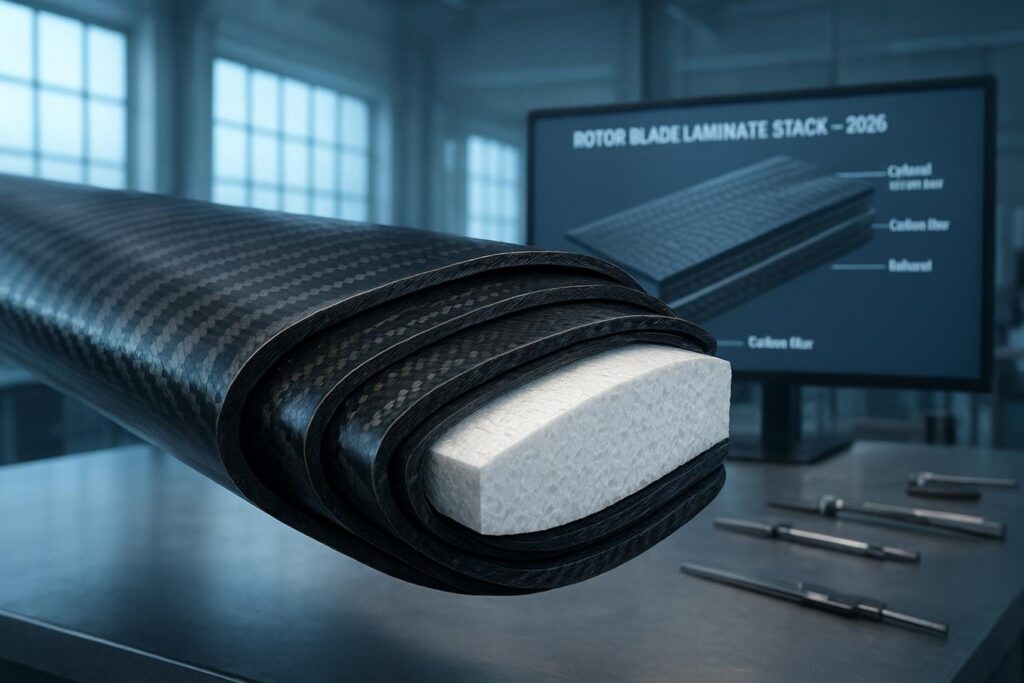
Common uses include pressure bulkheads, helicopter rotors, radomes, and internal structural parts. Grades like ROHACELL® XT and HERO are important for autoclave-cured parts, handling curing cycles up to 180°C and high pressures. ROHACELL® S provides improved fire behavior and meets FAR 25.853, helping meet strict safety rules. These benefits make it a key material for lightweight design and dependable structure.
Automotive Engineering: Lightweighting and Crash Performance
In automotive design, the push to reduce weight is strong because of fuel-efficiency rules and customer demand for better performance. Chem-Craft Rohacell Foam supports these goals by helping create lighter body panels, exterior parts, and structural components. Adding foam cores inside hollow chassis sections can turn empty space into load-bearing structure, cutting weight while improving torsional stiffness and crash energy handling.
Grades like ROHACELL® IG-F and HE are often used in automotive work because they offer a good balance of heat stability and strength for common manufacturing processes. The result can be vehicles that handle better, use less fuel, and offer improved safety.
Medical Device and Prosthetics Manufacturing
Medical devices often adopt new materials slowly, but they still need better performance and safe material behavior. Chem-Craft Rohacell Foam is used in prosthetics and medical devices where low weight, strength, and durability matter. The foam is physiologically inert and resists solvents, which helps for parts that may contact the body or go through cleaning and sterilization steps.
Approval timelines can be long for medical uses, especially for load-bearing prosthetics. Even so, Rohacell’s ability to support custom, lightweight, strong structures makes it useful for innovators. Grades like ROHACELL® IG-F and HF are used depending on the needed properties.
Electronics: RF, Microwave, and Antenna Components
In electronics-especially RF, microwave, and antenna parts-Chem-Craft Rohacell Foam is valued for its dielectric properties. Grades such as ROHACELL® HF are made with very low dielectric constants and good transmission at high frequencies. This makes them suitable for radomes and antennas where signal quality and transparency matter.
ROHACELL® EC and EC-HT offer high electromagnetic absorption for “Stealth” uses, showing how the material can also help manage electromagnetic signatures. Rohacell is also used in micro speakers for smartphones, where lightweight, accurate support is needed. The closed-cell structure supports dimensional stability, which matters for accurate electronic parts and printed circuit boards (PCBs).
Other Industrial Uses: Marine, Energy, and Sports Equipment
Chem-Craft Rohacell Foam is also used in many other areas. In marine applications, it supports lightweight, strong structures that resist corrosion and handle harsh environments. Grades like ROHACELL® HE and S fit well here, combining strength, heat stability, and (for S) improved fire resistance.
The energy sector uses it in parts for wind turbines and other renewable systems, where strong, lightweight materials can improve efficiency and reduce maintenance needs. In sports equipment-such as bikes, skis, and surfboards-Rohacell cores reduce weight and increase stiffness, improving performance and feel. Its strong properties support new designs that balance performance and durability across many products.
Future Trends and Innovations in Chem-Craft Rohacell Foam Composites
The use of Chem-Craft Rohacell Foam in high-performance composites is still growing. As industries push for better performance and new designs, demand for advanced materials like Rohacell continues to rise. Future work is expected to bring changes in mechanical performance, easier processing, and use in new products, driven by the need for lightweight and more sustainable solutions.
This progress is about meeting the needs of next-generation industrial products and keeping Rohacell as a leading option in composite technology, giving engineers more ways to improve efficiency, durability, and design.
Advances in Mechanical Performance and Processability
Research and development around Chem-Craft Rohacell Foam aims to improve mechanical performance and make processing easier. This can include new formulations that provide even higher specific strength, better fatigue resistance, or stronger performance under changing loads. Work may also aim to raise heat resistance further, so the foam can be used with higher-temperature resin systems or tougher curing cycles without losing strength or shape.
On the processing side, improvements may focus on easier machining, faster thermoforming, or better bonding with more facing materials and adhesives. The overall goal is to make Rohacell fit automated production methods better, reduce cycle time and cost, and support even more complex shapes.
Industry Moves Toward Lightweight and Sustainable Materials
Lightweight materials are now a major focus across most industries, driven by performance goals and environmental pressure. OEMs are increasingly choosing high-performance structural foam cores like Chem-Craft Rohacell Foam for future structures because they can reduce weight while keeping strong heat stability and meeting strict standards.
By improving stiffness-to-weight and handling heat well, these materials can reduce lifetime emissions by lowering fuel use in transport, improving energy efficiency during use, and helping products last longer. Even though Rohacell is not recyclable as raw material, its impact on overall system efficiency and durability supports broader sustainability goals.
Emerging Applications in Next-Generation Industrial Products
Chem-Craft Rohacell Foam is well positioned for new uses in next-generation industrial products. As areas like urban air mobility (flying cars), advanced robotics, and personalized medical devices grow, demand for lightweight, strong, heat-stable components will increase. Rohacell can be molded and machined into detailed 3D shapes, which suits complex structural parts in these new designs.
Possible future uses include smart infrastructure, where lightweight composite parts with built-in sensors could change how systems are monitored and maintained, and renewable energy, where larger turbine blades need core materials that can handle very high forces and outdoor exposure. As Rohacell materials and composite systems continue to improve, its role in future industrial products is likely to expand.
Also Read | Sourcing Heritage Bedding: Analyzing the Craftsmanship of Master Bed Makers