Introduction
Putting a hob on a kitchen island can make cooking feel more social and can create a practical focal point in an open-plan room. Instead of facing a wall, the person cooking can interact with family or guests while preparing food. However, there is an important issue that is easy to overlook: extraction. Moving the hob away from the wall changes how steam, grease, heat, and cooking odours need to be controlled.
An island hob can work extremely well, but its success depends on planning ventilation at the same time as the island itself. The extractor, ducting, ceiling, clearances, and cooking habits all need to be considered before installation. Understanding these issues early can help homeowners avoid an attractive kitchen layout that becomes difficult to ventilate.
Why Do Homeowners Put a Hob on a Kitchen Island?
In an open-plan kitchen, an island hob allows the cook to face the living or dining area rather than work with their back to the room. This can make everyday cooking more interactive, particularly when family members or guests are nearby.
An island can also bring the cooking zone closer to preparation and storage areas, depending on the overall layout. For some kitchens, moving the hob to the centre creates a more flexible workflow and leaves a wall available for tall storage or other appliances.
However, these benefits should be considered alongside the practical requirements. An island hob is not simply a wall-mounted hob moved to another location. Because there is open space around it, extraction requires more careful planning.
Why Is Extraction Harder When the Hob Is on an Island?
Cooking produces more than visible steam. Frying, grilling, boiling, and other high-temperature activities can release grease particles, moisture, heat, and odours into the surrounding air. When a hob is positioned against a wall, the extraction system can usually be planned around a fixed wall or a relatively straightforward duct route.
An island changes that arrangement. The cooking surface sits in a more open part of the room, so rising vapour can disperse before it reaches the extraction system. Air movement from windows, doors, heating systems, or other ventilation can also push cooking contaminants away from where they need to be captured. In an open-plan home, those contaminants may then move toward dining or living areas.
This does not mean an island hob cannot be properly ventilated. It means the extraction system should be treated as part of the kitchen design from the beginning. Its position, size, airflow path, ducting, and relationship with the cooking surface all deserve attention before the cabinets and ceiling are finalized.
What Extraction Options Can You Use Over an Island Hob?
Homeowners have several extraction approaches to consider, and the right option depends on the kitchen layout, installation possibilities, appearance, and cooking habits.
Overhead island extraction
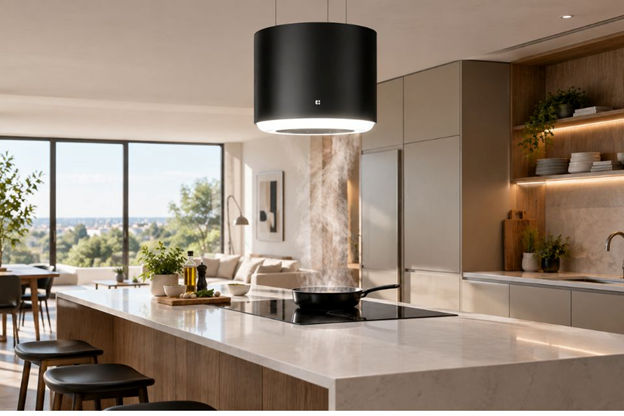
An overhead extractor is the most familiar solution. It is positioned above the cooking surface and is designed to capture rising cooking vapour before it spreads through the room. It can be an effective approach when correctly positioned and matched to the hob.
However, an overhead unit becomes a visible part of the kitchen. Homeowners should consider whether its size and position will affect sightlines across an open-plan room. Ducting also needs to be planned through the ceiling or another suitable route. When comparing options, an island extractor hood should therefore be considered as part of the complete kitchen layout rather than as an appliance added after the island has been designed.
Ceiling-mounted extraction
Ceiling-mounted systems can provide a less visually dominant alternative. Because the equipment is integrated into the ceiling, the kitchen can maintain clearer sightlines between the cooking, dining, and living areas. However, correct positioning is important because the distance between the extraction point and cooking surface affects how effectively rising vapour can be captured.
The ceiling structure and duct route also need early consideration.
Downdraft extraction
Downdraft systems take a different approach by drawing cooking vapour downward or toward an extraction point positioned close to the hob. Their low-profile appearance can appeal to homeowners who want an uninterrupted view across the kitchen.
Their suitability depends on the particular cooking setup and system design. They should not automatically be treated as a better replacement for overhead extraction. Homeowners should consider how they cook, what type of hob they use, and how the proposed system is designed to handle cooking vapour.
Recirculating extraction
Recirculating systems filter air and return it to the kitchen rather than sending it outside through a duct. This can be useful where external ducting is impractical. However, filter maintenance becomes an important part of ongoing use, and homeowners should follow the manufacturer’s requirements for cleaning or replacing filters.
Ducted or Recirculating: Which Extraction Method Makes More Sense?
Ducted extraction removes air from the kitchen and sends it outside through a suitable route. It can be attractive for homeowners who want cooking air physically removed from the room, but the installation may require more planning. The route, bends, ceiling space, external outlet, and structure of the property can all affect what is practical.
Recirculating extraction avoids the need for an external duct route. Air passes through filters before being returned to the kitchen. This can simplify installation, especially during certain renovations, but it does not remove the air from the home. Filter condition and maintenance therefore matter.
Neither approach is automatically right for every island kitchen. The decision should consider the building, available installation routes, cooking habits, and the extraction system being considered. Homeowners should resolve these questions before finalizing the island rather than adapting ventilation afterward.
7 Things to Check Before Putting a Hob on Your Island
1. Where will the extracted air go?
If you are considering ducted extraction, identify the route before the kitchen is installed. A complicated route can affect the ceiling, cabinets, cost, and final appearance.
2. Is the island large enough?
A hob needs appropriate surrounding workspace. The island should provide enough room for safe food preparation and normal kitchen activities rather than being designed around the cooking appliance alone.
3. How will ducting affect the ceiling or cabinetry?
Ductwork can influence ceiling construction, cabinet layouts, and visual proportions. Discussing it early can prevent expensive changes later.
4. How do you normally cook?
Frequent frying, grilling, or high-heat cooking can create more grease, vapour, and odours than occasional light cooking. Your habits should influence the extraction approach.
5. Is the kitchen open-plan?
In an open-plan home, cooking contaminants can travel beyond the kitchen. Consider how the cooking zone relates to nearby seating and dining spaces.
6. Will the extractor affect sightlines?
A large overhead extractor can become one of the most noticeable elements in the room. Consider its height, width, finish, and position before committing to the design.
7. Can extraction be planned before installation?
Extraction should be coordinated with electrical work, cabinetry, ceilings, and the island itself. Planning it last can limit the available options.
When Is a Hob on the Island Probably Not the Best Choice?
An island hob is not automatically the best solution for every kitchen. If the property has major restrictions on ducting, the additional installation complexity may outweigh the benefits of moving the cooking surface into the centre of the room. The same can apply when the island is relatively small and leaves limited workspace around the hob.
Cooking habits also matter. A homeowner who regularly fries, grills, or cooks for long periods may have different extraction requirements from someone who mainly prepares quick, low-steam meals. Very open-plan layouts deserve particular attention because cooking odours can travel into living and dining areas.
If a wall-mounted hob allows a more straightforward extraction route, easier installation, and a better-balanced work area, keeping the hob against the wall may be the more sensible choice. Good kitchen planning is not about following a trend; it is about matching the layout to the way the household actually uses the space.
How Can You Balance Extraction With Kitchen Design?
Good extraction does not have to undermine the appearance of an island kitchen. The key is to treat ventilation as a design requirement from the start. Homeowners can compare overhead, ceiling-integrated, downdraft, and recirculating approaches based on how visible the equipment will be and how well it fits the room.
Sightlines are particularly important in open-plan kitchens. An overhead extractor may create a strong visual focal point, while a concealed or lower-profile approach can preserve a more open feel. Ceiling height, island proportions, lighting, and the position of surrounding furniture should also be considered.
For homeowners exploring compact or design-conscious kitchen solutions, products such as Ciarra One can be considered as part of a wider comparison. The important point is to assess any product against the kitchen’s actual layout, cooking habits, installation requirements, and ventilation needs rather than choosing it on appearance alone.
So, Should You Put a Hob on Your Kitchen Island?
Yes, an island hob can be an excellent choice when the layout genuinely improves the way the kitchen is used and extraction has been planned properly. It can make cooking more social, improve visibility across an open-plan room, and create a strong central workspace.
However, it is worth reconsidering the idea when ducting is difficult, island space is limited, or installation complexity creates more compromises than benefits. A wall-mounted hob can sometimes provide a simpler and more practical solution.
The key decision is therefore not simply whether an island can accommodate a hob. It is whether the entire kitchen can accommodate the hob, extraction system, workspace, and ventilation requirements together.
Conclusion
A hob on a kitchen island can combine functionality and social interaction, but extraction should never be treated as an afterthought. Steam, grease, heat, and cooking odours behave differently when the cooking surface sits in an open area, making early ventilation planning especially important.
Before choosing the layout, consider the extraction route, island dimensions, cooking habits, open-plan airflow, and the visual impact of the chosen system. Comparing ducted, recirculating, overhead, ceiling, and downdraft approaches can help homeowners find a solution that fits both the kitchen and the way it is used. Homeowners looking for further kitchen ventilation options can explore Ciarra Appliances while comparing solutions for their own space.
FAQs
1. Is it a good idea to put a hob on a kitchen island?
Yes, an island hob can work well when the kitchen layout, available workspace, and extraction system are properly planned. The main consideration is whether cooking fumes, steam, grease, and heat can be effectively managed in the more open position.
2. Do you need an extractor hood over an island hob?
An appropriate extraction or ventilation solution is important for managing cooking pollutants and moisture. The specific approach can vary between an overhead extractor, ceiling-mounted system, downdraft solution, or recirculating system depending on the kitchen and installation requirements.
3. Is ducted extraction better than recirculating extraction for an island hob?
Neither is automatically better for every kitchen. Ducted extraction removes air from the room but requires a suitable route outside, while recirculating systems filter air and return it to the kitchen. The better choice depends on the property’s structure, installation possibilities, and cooking habits.
4. What should I consider before installing a hob on a kitchen island?
Consider the island’s size, extraction route, ceiling structure, ducting possibilities, cooking habits, open-plan layout, sightlines, and installation timing. Planning these elements before cabinetry and other work begins can prevent expensive modifications later.
5. Is a downdraft extractor suitable for an island hob?
A downdraft extractor can be suitable for some island kitchens, particularly where homeowners want less visual obstruction above the hob. However, suitability depends on the specific system, hob configuration, cooking habits, and kitchen layout, so it should be evaluated as part of the complete ventilation plan.